US coin · series

The Maryland Tercentenary Half Dollar

A 300-year-old colony, a borrowed portrait, and a public fight over a shirt collar.

The Maryland Tercentenary Half Dollar
No artist/photographer credit asserted; Wikimedia Commons uploader: Bobby131313 (work is public domain) · public domain · source

In 1934, Maryland turned 300 and minted a coin to prove it. Just 25,000 were struck — and before the dies were even cut, an argument broke out over whether a Catholic lord should be shown wearing a Puritan's collar.

The story behind the coin

In March 1634, two small ships — the Ark and the Dove — landed English settlers on the shore of what would become Maryland, founding the colony at St. Mary's City. Three hundred years later, the state wanted a coin to mark the moment.

The timing was no accident. By 1934 the United States was deep in the Great Depression, and commemorative half dollars had become a favorite way for towns, states, and committees to raise money. The deal was simple: Congress would authorize a special coin, the Mint would strike it at face value, and a local sponsor would sell it to collectors at a premium — keeping the difference. The coin was, in effect, a fundraiser with a portrait on it.

Maryland's two senators, Millard Tydings and Phillips Lee Goldsborough, introduced the bill on March 6, 1934. It met no opposition, and President Franklin Roosevelt signed it into law on May 9 — making this the first commemorative coin authorized under his administration. Congress capped the run at 25,000 pieces and handed exclusive sales rights to the Maryland Tercentenary Commission.

The design — and the collar fight

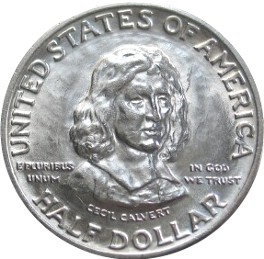
The obverse — the heads side — carries the face of Cecil Calvert, the 2nd Baron Baltimore, the man whose family founded and governed the colony. The reverse shows the arms of Maryland: the Calvert family shield quartered with that of his wife, Anne Arundell, under a banner bearing the state motto.

To make the portrait, sculptor Hans Schuler worked from a 17th-century painting by Gerard Soest. That's where the trouble started. When the Commission of Fine Arts reviewed the models, sculptor Lee Lawrie objected that Lord Baltimore's broad collar looked "more typical of Puritans" than of a Catholic Cavalier — the wrong costume for the wrong man. Schuler refused to change it, pointing to the Soest painting as his source.

The dispute outlived everyone involved. Later numismatists Anthony Swiatek and Walter Breen agreed the collar was an anachronism, and historian Don Taxay noted that Calvert's own colonial coinage shows him "in a loosely draped garment," not a stiff collar. Art historian Cornelius Vermeule was harsher still, complaining the coin "looks more like an advertising medal" and that the reverse "could almost be a policeman's badge." The motto itself — Fatti Maschii Parole Femine — drew its own modern reckoning: long rendered "deeds are manly, words womanly," it was officially reinterpreted by Maryland's legislature in 2017 as "strong deeds, gentle words."

Key facts

Year struck
1934 (single year)
Anniversary
300th of Maryland's 1634 founding
Designer
Hans Schuler (obverse and reverse)
Obverse
Cecil Calvert, 2nd Baron Baltimore
Reverse
Arms of Maryland
Mint
Philadelphia (no mint mark)
Mintage
25,000 for sale (+15 for the Assay Commission)
Composition
90% silver, 10% copper
Weight
12.5 g
Diameter
30.6 mm
Edge
Reeded
Issue price
$1.00, later cut to $0.75 then $0.65

Collecting it

Here is the unusual part: the whole story lives in one date. Every Maryland Tercentenary half dollar is a 1934 Philadelphia coin with no mint mark — there are no rare branch-mint partners and no scarce varieties to hunt. None of the 25,000 were melted, so the entire authorized run reached the public.

That makes condition the whole game. Roughly 15,000 sold by the end of 1934 at a dollar each; when the celebration faded, the Commission cut the price and moved the rest, with about 8,000 going to dealers in bulk. Coins handled in bulk and sold cheap were not always treated gently, so high-grade examples with full, original surfaces command a real premium over worn or scuffed ones. A handful of proof specimens — coins struck with special care on polished dies, the "show" pieces — are the genuine rarities; only a few are known, two once owned by Mint Chief Engraver John R. Sinnock, and one brought $109,250 at auction in 2012.

For a newcomer, that's the appeal: a single coin, a complete story, and a clear ladder of value that runs almost entirely on how well the piece survived its first ninety years.

Questions collectors ask

Who is on the Maryland Tercentenary half dollar?

The obverse shows Cecil Calvert, the 2nd Baron Baltimore, whose family founded and governed colonial Maryland. The reverse shows the arms of Maryland — the Calvert shield quartered with that of his wife, Anne Arundell.

How many Maryland half dollars were made?

Congress authorized 25,000 for sale, plus 15 more reserved for the Assay Commission's annual testing. None were melted, so essentially the full run reached collectors — making it a moderately scarce but not rare commemorative.

Why is there a controversy about Lord Baltimore's collar?

Designer Hans Schuler copied the portrait from a 17th-century painting by Gerard Soest, which shows a broad collar. Reviewers argued the collar looked Puritan and was the wrong dress for a Catholic Cavalier. Schuler refused to change it, and numismatists have debated the anachronism ever since.

Is the 1934 Maryland half dollar rare?

Not in the strict sense — all 25,000 survive in collector hands. Value is driven by grade: well-preserved, lustrous examples are scarce and bring strong prices, while the only true rarities are the few known proof specimens.

Are there different dates or mint marks to collect?

No. The coin was struck only in 1934 at the Philadelphia Mint and carries no mint mark. There is one date, one mint, and no major varieties — the set is a single coin.

Sources