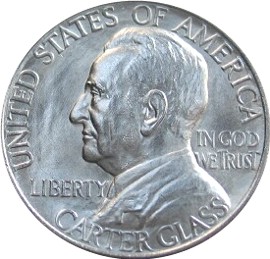
US coin · series

The 1936 Lynchburg Half Dollar

The coin a U.S. senator phoned the Mint trying to stop — because his own face was on it.

The 1936 Lynchburg Half Dollar
Public domain · source

In 1936, Senator Carter Glass of Virginia called the Philadelphia Mint to ask whether any law could keep a living person off a U.S. coin. He was asking about himself. The answer was no — and so his portrait went onto the Lynchburg half dollar anyway, against his wishes.

The story behind the coin

In 1786, the Virginia General Assembly incorporated a small tobacco town on the James River as the town of Lynchburg. A hundred and fifty years later, the city wanted a coin to mark the moment.

That was an easy wish to grant in 1936. It was the wildest year in the history of American commemorative coins — sixteen new issues in a single twelve-month stretch. Collectors had watched earlier commemoratives climb above their issue prices, money looked easy, and promoters across the country raced to get their own town or anniversary minted. Lynchburg joined the rush.

Its champion in Washington was the city's most famous son: Carter Glass, U.S. senator, former Secretary of the Treasury, and a principal architect of the Federal Reserve. Glass introduced the authorizing bill on April 8, 1936. It passed both houses without recorded opposition, and President Franklin Roosevelt signed it into law on May 28, 1936. The act authorized 20,000 coins.

Then came the awkward part. The design committee wanted Glass himself on the obverse — the heads side of the coin. Glass did not. He protested, and, as the story goes, telephoned the Philadelphia Mint hoping some rule would forbid a living person from appearing on the coinage. He was told no such law existed. The portrait stayed.

What the coin shows

The designs came from Charles Keck, a New York sculptor who had already shaped earlier commemoratives. He gave the Lynchburg half dollar a quietly civic feel.

The obverse carries the bust of Carter Glass — making this the third U.S. coin to depict a living person, and the first to show one alone. (His objection makes that distinction one of the stranger footnotes in American coinage: an honor pressed on a man who tried to refuse it.)

The reverse turns to the city itself. The Goddess of Liberty stands in the foreground, and behind her Keck set the landmarks of Lynchburg's Monument Terrace — the Old Lynchburg Courthouse and a Confederate monument among them. It is a portrait of a place as much as a person.

Key facts

Year struck
1936 (one year only)
Denomination
Half dollar (50 cents)
Designer
Charles Keck (obverse and reverse)
Obverse
Senator Carter Glass — first living person shown alone on a U.S. coin
Reverse
Liberty before Lynchburg's Monument Terrace (Old Courthouse, Confederate monument)
Mint
Philadelphia (no mint mark)
Mintage
20,000 for sale, plus 13 reserved for assay (20,013 total)
Composition
90% silver, 10% copper
Weight
12.50 g
Diameter
30.6 mm
Edge
Reeded
Original issue price
$1 each, limit 10 per buyer
Sponsor
Lynchburg Sesqui-Centennial Association

Collecting the Lynchburg half dollar

By the standards of 1936, this was an honest issue. There was one mint, one date, and no mint-mark trickery — none of the deliberately split, low-mintage "instant rarities" that promoters were manufacturing elsewhere that year and that soon pushed Congress to shut the whole program down by 1939.

The coin's scarcity comes from a simpler fact: only 20,000 were made for collectors, and they sold out. None were returned to the Mint to be melted, so the survivors are essentially the entire original issue, minus loss and wear over ninety years.

For collectors, the action is in the grade — the condition. Because these were sold to careful hobbyists rather than spent, many survive in mint state (uncirculated, never carried in pocket change). The premium climbs steeply for the highest grades, where a sharp strike and clean, unmarked surfaces are genuinely scarce. The single-year, single-mint design also makes it a one-coin set: own one well-struck example and you've completed the type.

Questions collectors ask

Why is Carter Glass on a coin he didn't want to be on?

The committee behind the 1936 commemorative chose to honor Lynchburg's most prominent native son. Glass objected and reportedly called the Philadelphia Mint hoping a law barred living people from the coinage. No such law existed, so his portrait was used over his protest — making him the first living person shown alone on a U.S. coin.

How many Lynchburg half dollars were made?

The Philadelphia Mint struck 20,000 for sale to the public, plus 13 extra reserved for the 1937 Assay Commission — 20,013 in all. The 20,000 sold out and none were returned to the Mint, so survivors are essentially the full original issue.

Is there more than one date or mint mark?

No. The Lynchburg half dollar was struck only in 1936, only at Philadelphia, with no mint mark. It is a one-coin type — unlike many 1936 commemoratives that were split across mints to create artificial rarities.

What was the coin sold for, and what is it worth now?

The Lynchburg Sesqui-Centennial Association sold them at $1 each, with a limit of 10 per buyer. Today the value depends almost entirely on grade; common uncirculated examples trade for a modest premium, while top-grade pieces with sharp strikes and clean surfaces command far more. Check current listings for live prices.

What does the reverse depict?

Liberty stands in the foreground, with the landmarks of Lynchburg's Monument Terrace behind her — the Old Lynchburg Courthouse and a Confederate monument among them.

Sources