US coin · series

The Silver Dollar That Sold Out — Twice Over

In 2009, the U.S. Mint put 43 words of the Gettysburg Address on a coin, and the entire run vanished in weeks.

The Silver Dollar That Sold Out — Twice Over
United States Mint (www.usmint.gov) · public domain · source

Two hundred years after a baby was born in a Kentucky log cabin, the U.S. Mint struck a silver dollar in his honor — and the public bought every single one. The 2009 Abraham Lincoln Bicentennial silver dollar is the rare modern commemorative that hit its legal ceiling and stopped.

The story behind the coin

On February 12, 2009, lines formed at the U.S. Mint's website. The date was no accident — it was Abraham Lincoln's 200th birthday, two centuries to the day since his birth in a one-room Kentucky cabin in 1809.

Congress had set the stage three years earlier. The Abraham Lincoln Commemorative Coin Act (Public Law 109-285), signed September 27, 2006, ordered a single silver dollar to mark the bicentennial — and capped it hard at 500,000 coins, across every version the Mint cared to sell.

That cap turned out to matter. Most modern commemoratives never come close to their limits; the Mint quietly melts the leftovers. This one was different. The public bought all 500,000. It is one of the few modern U.S. commemoratives to completely sell out — the run didn't trickle to an end, it hit a wall.

Why the frenzy? Part of it was Lincoln. Part of it was timing — 2009 was a Lincoln year across the board, with four new cent designs marking the same bicentennial. And part of it was the coin itself, which did something American silver dollars almost never do.

The design

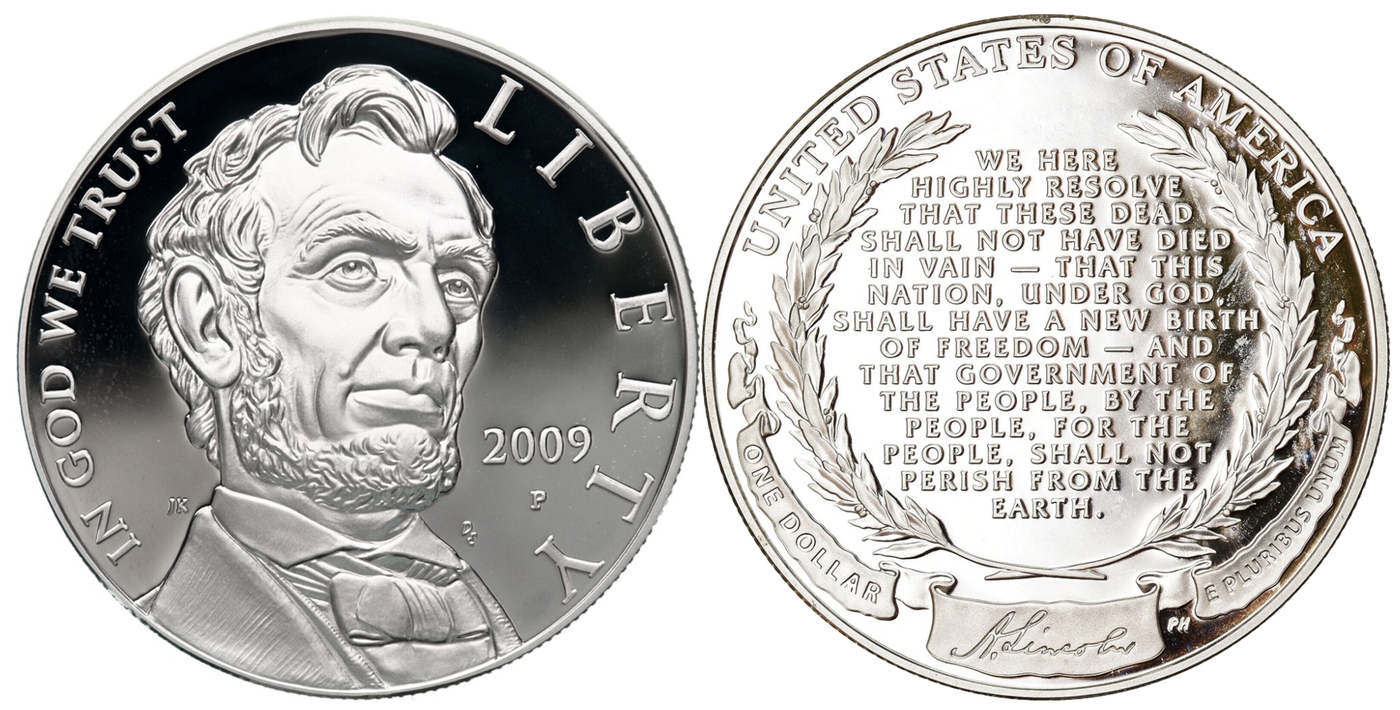
The obverse — the heads side — is a Lincoln you already know, even if you've never held this coin. The portrait draws on Daniel Chester French's seated marble giant in the Lincoln Memorial, the same brooding figure that stares down the National Mall. It was designed by Justin Kunz and sculpted into the dies by U.S. Mint engraver Don Everhart.

Turn it over, and the coin does its trick. There is no eagle, no allegorical Liberty, no monument. Instead, the reverse carries words — the final 43 words of the Gettysburg Address, ringed by a laurel wreath:

"…we here highly resolve that these dead shall not have died in vain — that this nation, under God, shall have a new birth of freedom — and that government of the people, by the people, for the people, shall not perish from the earth."

Below the wreath sits Lincoln's own signature on a curling banner, between ONE DOLLAR and E PLURIBUS UNUM. The reverse was designed and engraved by Mint sculptor-engraver Phebe Hemphill. The two designs were unveiled together on November 19, 2008 — the 145th anniversary of the speech itself.

It's a quiet, text-heavy reverse, and that's the point. The coin asks you to read it. A die — the hardened steel stamp that strikes the design into the blank — had to hold all 43 of those words in crisp relief (the raised lettering you feel with a thumbnail), which is part of why high-grade examples reward close inspection.

Key facts

Year struck
2009 only
Denomination
Silver dollar ($1 commemorative)
Obverse designer
Justin Kunz (sculpted by Don Everhart)
Reverse designer
Phebe Hemphill
Composition
90% silver, 10% copper
Weight / diameter
26.73 g · 38.1 mm · reeded edge
Mint
Philadelphia (P mint mark)
Maximum authorized
500,000 across all versions
Final sales
372,224 proof · 127,710 uncirculated (≈ full sellout)
Surcharge
$10 per coin to the Abraham Lincoln Bicentennial Commission
First released
February 12, 2009 — Lincoln's 200th birthday

Collecting it

There is only one date and one mint mark here: every coin is a 2009-P from Philadelphia. So this is not a hunt across years — it's a hunt across quality. Because the whole run sold out, the supply is fixed and the population is well-mapped; the chase is for the top of the grade scale.

The coin came in two finishes. The proof — struck twice on polished dies for mirror fields and frosted devices — sold the most, at 372,224 pieces. The uncirculated (sometimes called the burnished business strike) was scarcer, at 127,710. The numbers were close enough to the 500,000 cap that the Mint effectively cleared its inventory.

A slice of the proofs had a second life. Fifty thousand were held back for the Lincoln Coin and Chronicles Set, released October 15, 2009, pairing the silver dollar with the four 2009 Lincoln cents and a Lincoln medal. Limited to 50,000 sets at one per household, it reportedly sold out in under two days. A silver dollar that arrived in a Chronicles set, still sealed, tells a slightly different provenance story than a single coin bought loose — worth knowing when you read a holder's label.

For graded, slabbed examples, the meaningful line is at the top: a flawless proof (PR70 / PF70) or a perfect uncirculated (MS70) commands a premium over the merely excellent 69s, precisely because all those tiny Gettysburg letters give a grader more places to find a flaw. Below the collector premium sits a floor: each coin holds roughly three-quarters of a troy ounce of silver, so its melt value moves with the metal.

Questions collectors ask

Is this the 1909 penny? Why does it say 2009?

Different coin entirely. The famous 1909 Lincoln cent marked Lincoln's 100th birthday and was the first U.S. coin to show a real person. This is the 2009 silver dollar, struck for his 200th — the bicentennial. Same man, a century apart.

Why did this commemorative sell out when most don't?

Two reasons. Congress capped it low — 500,000 coins across every version — and demand ran hot in a banner Lincoln year. The Mint sold the whole authorized run, which makes this one of the rare modern U.S. commemoratives to actually hit its ceiling rather than have leftovers melted.

What's written on the back?

The last 43 words of the Gettysburg Address, inside a laurel wreath, with Lincoln's signature below. No eagle, no Liberty — just the speech. It's one of the most text-forward reverses on any modern U.S. coin.

Proof or uncirculated — which is rarer?

The uncirculated is scarcer: 127,710 struck versus 372,224 proofs. The proof has the mirror-and-frost look most people picture; the uncirculated is a satiny business strike. Fifty thousand of the proofs went into the separate Lincoln Coin and Chronicles Set.

Where was it minted, and does it have a mint mark?

All were struck at the Philadelphia Mint and carry a 'P' mint mark. There is no other mint or year for this coin.

Did buying one support anything?

Yes. A $10 surcharge on every coin went to the Abraham Lincoln Bicentennial Commission, the federal body that organized the 2009 anniversary observances.

Sources