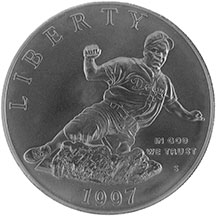
The story behind the coin
On April 15, 1947, Jackie Robinson walked onto Ebbets Field as a Brooklyn Dodger and became the first Black player in the modern major leagues. He did it under a torrent of abuse, and he did it brilliantly — Rookie of the Year that season, a Hall of Famer by 1962. His debut is one of the hinge moments of 20th-century American life, as much a civil-rights story as a baseball one.
Fifty years on, Congress decided that anniversary deserved a coin. The United States Commemorative Coin Act of 1996 (Public Law 104-329) authorized a Jackie Robinson program: a five-dollar gold piece and this silver dollar, struck in 1997. A surcharge built into each coin's price was directed to the Jackie Robinson Foundation, which funds college scholarships for minority students — so buying the coin was, in part, paying it forward to the cause Robinson championed.
Here's the twist. Congress capped the whole silver-dollar program at 200,000 coins — the lowest authorized ceiling of any modern silver commemorative. It needn't have worried. Collectors bought a healthy 110,002 of the mirror-finish proof version (a proof is a specially polished collector strike), but only 30,180 of the plain uncirculated coin. That tiny number, born of pure market indifference, is why this otherwise quiet coin is now chased.