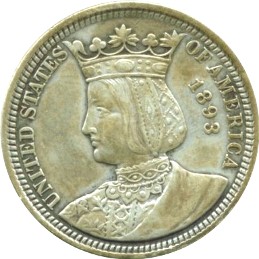
The story behind the coin
The 1893 World's Columbian Exposition in Chicago was the largest thing the United States had ever built — a temporary white city raised to mark 400 years since Columbus sailed. Inside it sat the Woman's Building, run by the Board of Lady Managers, a group of socialites and organizers led by Bertha Honoré Palmer, wife of the Chicago real estate magnate Potter Palmer.
The fair already had a souvenir coin coming: the Columbian half dollar, the first U.S. commemorative coin ever authorized. The Lady Managers thought it was clumsy. They wanted something of their own — a coin to fund the Woman's Building, designed by a woman, that would prove women could make something more beautiful than the men had. They went to Congress and got it.
The result was the Isabella quarter, struck in 1893. It was the first commemorative quarter dollar in U.S. history, and only the second commemorative coin the Mint had ever made. It was also the first U.S. coin to put a real woman — Queen Isabella I of Castile, the monarch who funded Columbus — on the obverse (the "heads" side), and a working woman on the back. For a country that had spent a century stamping Liberty as an allegory, that was something new.
There was just one problem. The women wanted to control the art. The Mint did not agree.