US coin · series

The Flowing Hair Half Dollar — America's First Fifty-Cent Piece

Hand-struck in the Mint's opening years, a coin made before the country was sure it could make coins at all.

The Flowing Hair Half Dollar — America's First Fifty-Cent Piece
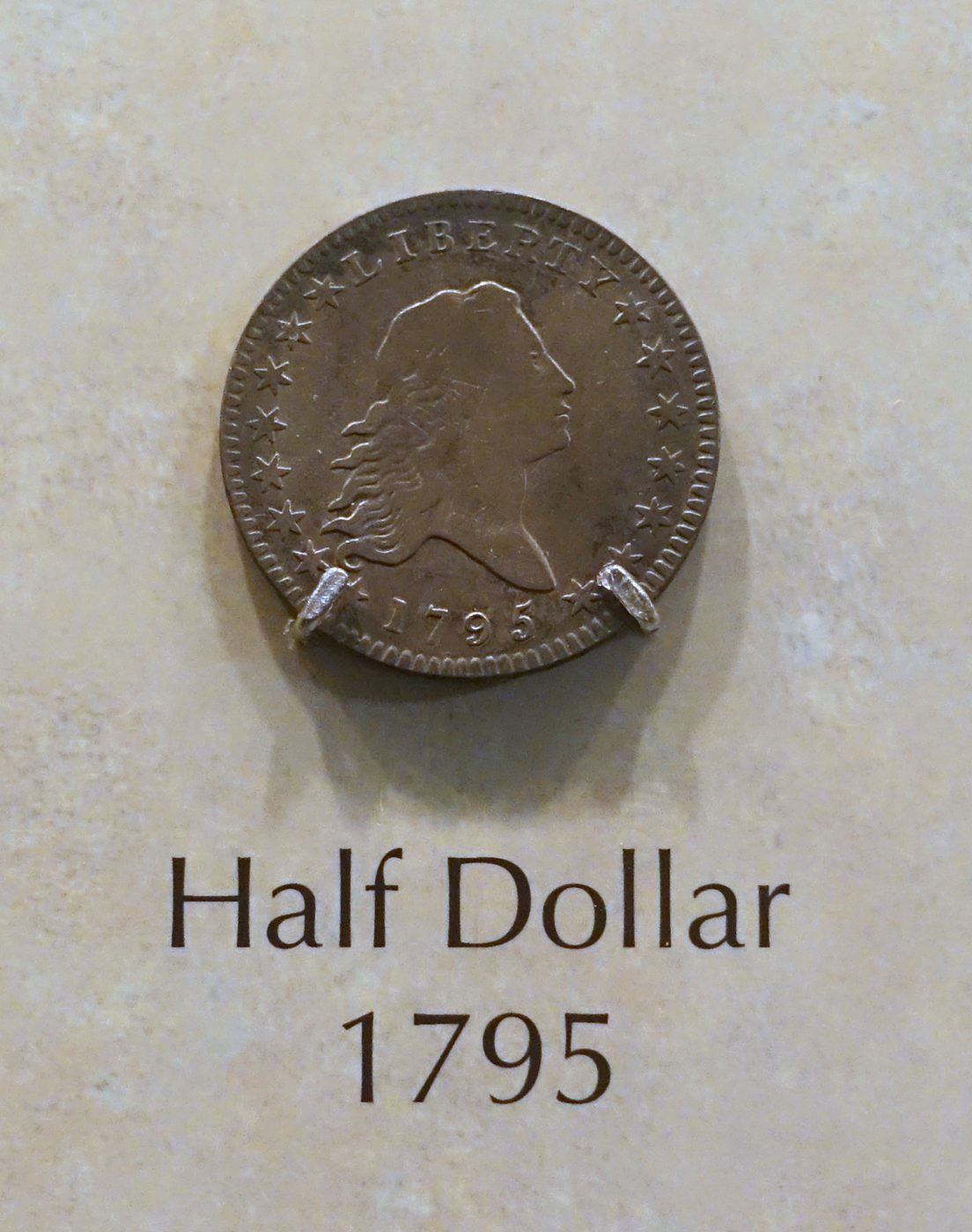
Photograph by Daderot (Wikimedia Commons), National Museum of American History (National Numismatic Collection), Smithsonian Institution · CC0 · source

In 1794, a brand-new government in a brand-new building tried to do something it had never done: strike its own silver money. The Flowing Hair Half Dollar was one of the first results — crude, scarce, and now among the most coveted coins in American numismatics.

The story behind the coin

For its first eighteen years, the United States had no money of its own. People paid for things with Spanish dollars, British shillings, and a jumble of foreign silver that nobody fully trusted. The Coinage Act of 1792 was meant to fix that — it created the Mint, set the dollar as the unit, and authorized the country to strike its own silver and gold instead of borrowing the world's.

Doing it turned out to be harder than passing the law. The Mint needed its officers to post surety bonds before it could legally handle precious metal, and those bonds weren't in place until 1794. Only then could silver coinage begin. The half dollar was among the very first to roll off the presses — the first fifty-cent piece the nation ever made.

It began as a trickle. The first delivery in late 1794 was just 5,300 coins, struck on rudimentary presses by hand. The Mint dated dies by the year they were cut, not the year they were used, so an additional 18,164 pieces struck in early 1795 still carried the 1794 date — bringing the first-year total to 23,464. The next year the Mint found its footing and struck roughly 300,000 more. Two years later the design was gone, replaced by the Draped Bust. That short run is exactly what makes it a prize.

The design & who made it

The man behind it was Robert Scot, a Scottish-born engraver from Edinburgh who had cut currency plates in Virginia before becoming the first Chief Engraver of the United States Mint in 1793. Scot designed both sides of the coin — the obverse (the heads side) and the reverse (the tails side).

The obverse — the heads side — shows Liberty as a young woman facing right, her hair streaming loose behind her. That flowing hair wasn't decoration; it was the point. Congress had asked for a design "emblematic of Liberty," and unbound hair was Scot's shorthand for freedom. Above her reads LIBERTY; below, the date; around the edge, fifteen six-pointed stars — one for each state in the Union at the time.

The reverse — the tails side — carries a small, spread-winged eagle perched on a rock, ringed by a laurel wreath, with UNITED STATES OF AMERICA around it. There's no denomination stamped on either face. Instead, the value runs around the edge: a lettered edge reading FIFTY CENTS OR HALF A DOLLAR. The Mint was new at this, and it shows — strikes are often soft, planchets (the blank metal discs) varied, and small details wandered from die to die. Those rough edges are part of the coin's honesty.

Key facts

Years struck
1794–1795
Denomination
Half dollar (50 cents)
Designer
Robert Scot (obverse and reverse)
Mint
Philadelphia (no mint mark)
Composition
.8924 silver / .1076 copper (the 1792 Act standard)
Weight
≈13.48 g
Diameter
≈32.5 mm
Edge
Lettered — FIFTY CENTS OR HALF A DOLLAR
Obverse stars
15 (one per state then in the Union)
1794 mintage
23,464
1795 mintage
≈299,680

Collecting it: key dates, varieties, and why grade matters

The whole type is collectible in just two dates, but they are worlds apart. The 1795 is the affordable, attainable end — with roughly 300,000 struck, it's the coin most people start with, and it can be found in well-worn grades without a fortune. The 1794 is the trophy. With only 23,464 made and a survival estimate of perhaps a few hundred coins across all grades, it's a genuine first-year rarity that anchors the entire series.

For collectors who go deeper, the series rewards study by die variety. Specialists catalog these by Overton numbers (from Al Overton's standard reference) — the 1794 has about 10 recognized varieties and the 1795 has 32. The most famous is the 1795 "Three Leaves": normally the eagle has two leaves in the clump beneath each wing, but a few die pairings show three. That small difference makes those coins quite scarce and keenly hunted. Recut dates also turn up on 1795 pieces, and — remarkably — a brand-new 1795 variety was confirmed by PCGS as recently as the 2020s, the first new one identified in nearly a century. The series isn't finished giving up its secrets.

High grades are where the air gets thin. These coins circulated hard in a cash-starved economy, the Mint's early striking was uneven, and silver was routinely melted when bullion prices rose. A Flowing Hair Half in true Mint State is a survivor against long odds, and the market prices it that way: a single top-grade 1794 has sold at auction for well over $800,000. For most collectors, a clean, honestly worn example with a strong portrait and readable date is the realistic and deeply satisfying goal.

Questions collectors ask

Why is the 1794 Flowing Hair Half Dollar so valuable?

It's a first-year rarity. The 1794 had a mintage of just 23,464 — the very first half dollars the United States ever struck — and only a few hundred are believed to survive in any grade. Scarcity, first-year status, and historical weight all push values high, with the finest example selling for hundreds of thousands of dollars.

Who designed the Flowing Hair Half Dollar?

Robert Scot, the first Chief Engraver of the United States Mint. He designed both the obverse and the reverse, and the same Flowing Hair portrait also appeared on the 1794–1795 half dime and silver dollar.

Why doesn't the coin say 'fifty cents' on the front or back?

The denomination is on the edge. The coin has a lettered edge reading FIFTY CENTS OR HALF A DOLLAR — an early practice the Mint used before stamping the value on the face of the coin.

What is the 1795 'Three Leaves' variety?

On most 1795 halves, the eagle has two leaves in the clump under each wing. On a few die pairings there are three leaves instead. Those 'Three Leaves' coins are scarcer and command a premium among variety collectors.

What is the Flowing Hair Half Dollar made of?

An alloy of about 89.24% silver and 10.76% copper — the unusual standard written into the Coinage Act of 1792. (The familiar 90% silver standard for US coinage came later, in 1837.)

How many years was the Flowing Hair design used on the half dollar?

Only two — 1794 and 1795. In 1796 it was replaced by the Draped Bust design, which makes Flowing Hair a short, sought-after two-year type.

Sources