US coin · series

The 2003 First Flight Centennial Silver Dollar

A coin for twelve seconds that changed the world.

The 2003 First Flight Centennial Silver Dollar
United States Mint · public domain · source

On December 17, 1903, a homemade machine left the sand at Kill Devil Hills and stayed in the air for twelve seconds. A century later, the U.S. Mint put that moment on a silver dollar — the Wright brothers on one side, their fragile Flyer on the other.

The story behind the coin

The first flight lasted twelve seconds and covered about 120 feet — shorter than the wingspan of a modern jetliner. Two bicycle makers from Dayton, Ohio, had built the machine themselves and flown it over the dunes near Kitty Hawk, North Carolina. For a hundred years, almost nothing changed the world faster.

By 2003, the centennial was coming, and Congress wanted a coin to mark it. The authority already existed: Public Law 105-124, passed in 1997, had set up a three-coin program years in advance. When the anniversary year arrived, the Mint struck all three — a copper-nickel clad half dollar, this silver dollar, and a ten-dollar gold coin.

The dollar was the heart of the set. It carried the surcharge that gave the program its purpose: $10 from every silver dollar sold went to the First Flight Centennial Foundation, the North Carolina group organizing the hundred-year celebration at Kitty Hawk. A commemorative coin is partly a fundraiser by law — you buy the coin, and a fixed amount funds the cause it honors.

The design

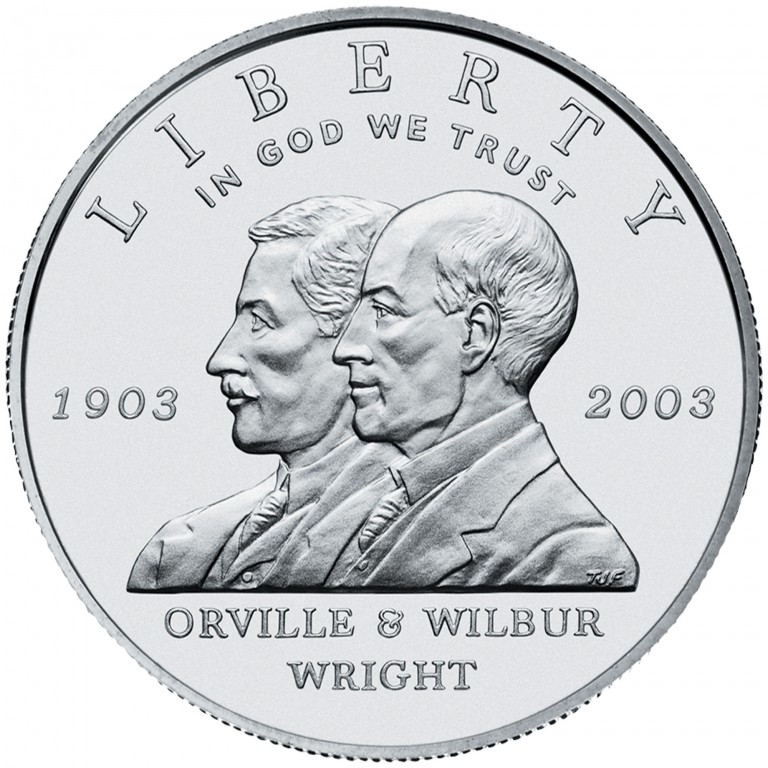
The obverse — the heads side — shows Orville and Wilbur Wright in profile, facing left, the two brothers who shared the work and the credit equally. It was modeled by U.S. Mint sculptor-engraver Thomas James "Jim" Ferrell, whose initials TJF sit on the design. Around them run the words LIBERTY, IN GOD WE TRUST, and the twin dates 1903 and 2003 — a hundred years bridged on one face. (Some accounts trace the brothers' portrait back to a George T. Morgan design from a 1909 Congressional medal honoring the Wrights; that lineage is repeated in collector write-ups but is not confirmed by the Mint's own description, so treat it as a likely-but-unverified story.)

The reverse — the tails side — is the one people remember: the Wright 1903 Flyer in flight, low over the dunes at Kill Devil Hill, the exact place it happened. It was designed by Mint sculptor-engraver Norman E. Nemeth, whose initials NEN appear in the field. The scene is plain and quiet — a flimsy biplane, a bank of sand, open air — which is the point. There was nothing grand about that morning except what it meant.

Key facts

Denomination
Silver dollar ($1)
Year struck
2003 (one year only)
Mint mark
P — Philadelphia
Obverse designer
Thomas James "Jim" Ferrell (U.S. Mint)
Reverse designer
Norman E. Nemeth (U.S. Mint)
Composition
90% silver, 10% copper
Weight / diameter
26.73 g / 38.1 mm
Edge
Reeded
Maximum authorized
500,000 (Public Law 105-124)
Proof struck
190,240
Uncirculated struck
53,533
Surcharge
$10 per coin → First Flight Centennial Foundation
On sale
August 1, 2003 – July 31, 2004

Collecting it

This is a one-year coin, sold by the Mint for a single twelve-month window and never struck again. That fixes the supply for good — there is no later date, no second mint mark, no chasing varieties across decades.

The set sold modestly. Against a ceiling of 500,000 dollars, the Mint sold 190,240 proofs and just 53,533 uncirculated coins — roughly half the authorized total, a common fate for early-2000s commemoratives that competed for collectors' attention against a crowded calendar of programs. (A proof is a specially struck coin with mirror-like fields and frosted devices, made for collectors; an uncirculated — or business-strike — commemorative has the normal satin finish.)

That low uncirculated figure is the quiet story here. The plain uncirculated dollar was made in well under a third of the proof's numbers, so for collectors who care about how few exist, it is the scarcer of the two finishes despite usually costing less attention. As with any modern commemorative, the prize is the top of the grading scale: a coin certified at the highest mint-state or proof grades, where flawless examples are far fewer than the raw mintage suggests.

Questions collectors ask

What does the 2003 First Flight silver dollar commemorate?

The 100th anniversary of the Wright brothers' first powered flight on December 17, 1903, near Kitty Hawk, North Carolina. The obverse shows Orville and Wilbur Wright; the reverse shows the 1903 Flyer over the dunes at Kill Devil Hill.

Who designed the coin?

The obverse (the Wright brothers) was modeled by U.S. Mint sculptor-engraver Thomas James "Jim" Ferrell. The reverse (the Flyer) was designed by Mint sculptor-engraver Norman E. Nemeth.

How many were made?

Congress authorized up to 500,000 silver dollars. The Mint actually sold 190,240 proofs and 53,533 uncirculated coins — together about half the ceiling. The uncirculated version is by far the scarcer of the two.

Is it real silver?

Yes. It is 90% silver and 10% copper, weighs 26.73 grams, and measures 38.1 mm — the same size and standard as a classic U.S. silver dollar.

Where was the $10 surcharge sent?

Every silver dollar carried a $10 surcharge paid to the First Flight Centennial Foundation, the North Carolina organization behind the hundred-year celebration at Kitty Hawk.

Why is there only a 'P' mint mark?

All First Flight silver dollars were struck at the Philadelphia Mint, so every coin carries a P. (The companion $10 gold coin was struck at West Point with a W.)

Sources