US coin · series

The Bicentennial Eisenhower Dollar

A 22-year-old student put the Liberty Bell on the Moon — and onto 200 million coins.

The Bicentennial Eisenhower Dollar
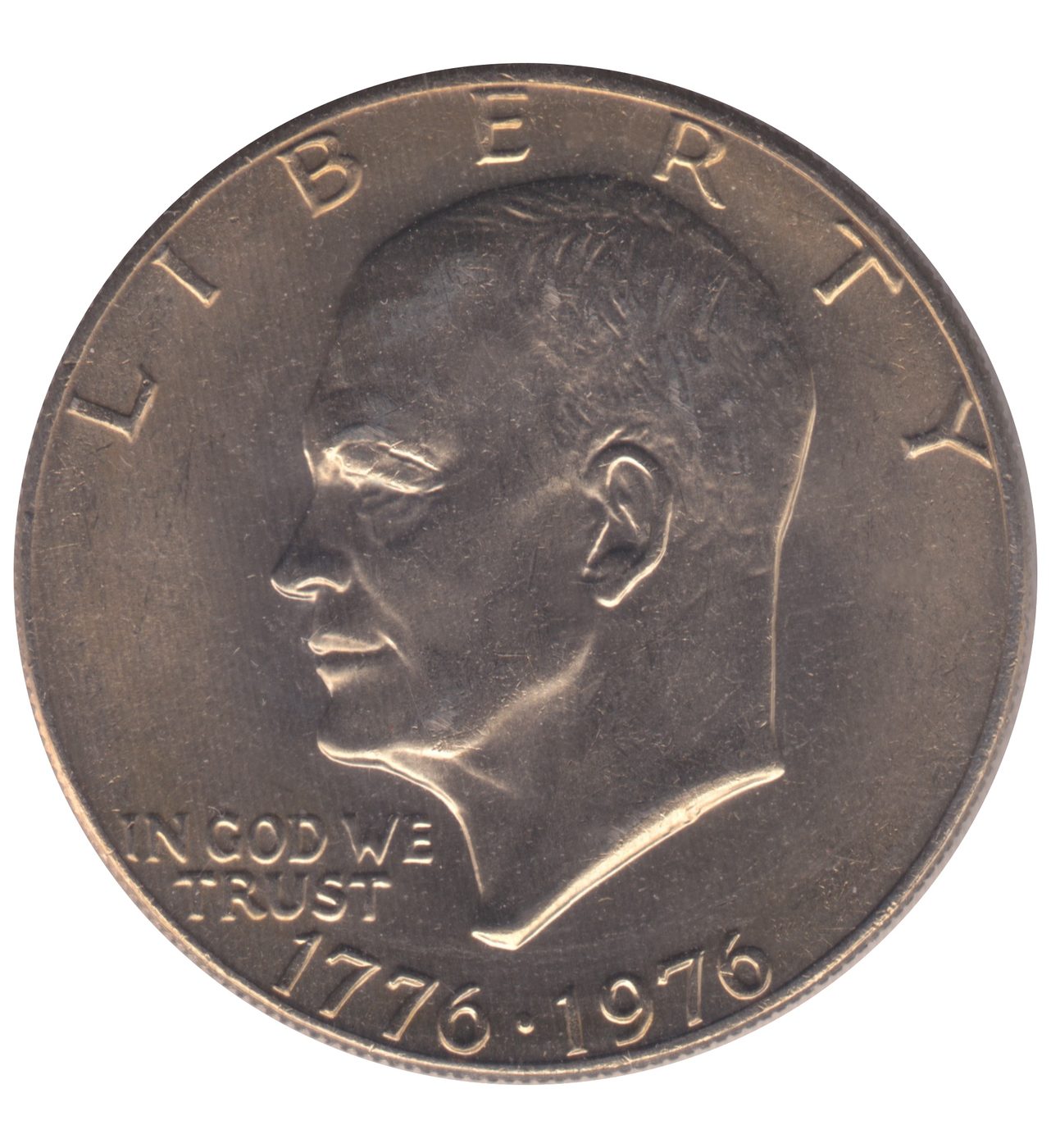
Coin designed by Frank Gasparro; photograph by Wikimedia user Wehwalt · public domain · source

In 1974 the U.S. Mint asked the whole country to design a coin for America's 200th birthday. The dollar went to a 22-year-old art student who set the Liberty Bell against the surface of the Moon — the youngest person ever to design a circulating U.S. coin.

The story behind the coin

In 1973, the United States was about to turn 200, and Congress wanted the milestone in people's pockets. The law it passed in October that year did something the Mint almost never does: it temporarily rewrote the back of three circulating coins — the quarter, the half dollar, and the dollar — and stamped them all with a dual date, 1776-1976.

The dollar in question was the Eisenhower dollar, nicknamed the "Ike." It was already a young coin. After President Dwight D. Eisenhower died in March 1969 and Apollo 11 landed on the Moon that July, Congress created a big new dollar to honor both — the eagle on its reverse (the "tails" side) was lifted from the Apollo 11 mission patch. Production started in 1971. So when the Bicentennial program arrived, the Ike was the natural coin to carry the nation's birthday.

Here is the part that makes it unusual. Instead of handing the new reverse to its own engravers, the Mint threw it open to the public — a national design competition with a $5,000 prize for each winning denomination. Thousands entered. The dollar went to Dennis R. Williams, a 22-year-old art student. The most famous coin of the Bicentennial year was, in part, homework.

The design and who made it

Williams's idea was simple and patriotic: the Liberty Bell, the cracked icon of 1776, set in front of a cratered Moon — a nod to how far the country had traveled, from a Philadelphia bell to a lunar landing. He was a student at the Columbus College of Art and Design in Ohio, and his win made him the youngest person ever to design a circulating U.S. coin. His initials, DRW, sit on the reverse.

A coin design has to survive the brutal physics of being stamped a hundred million times, and Williams's drawing needed an engraver's hand to get there. That hand belonged to Frank Gasparro, the Mint's Chief Engraver, who simplified the lunar detail and reworked the bell and lettering so the dies would strike cleanly. Gasparro was no stranger to the coin — he had modeled the obverse (the "heads" side), the portrait of Eisenhower, back in 1971. He admired the late president and considered the portrait an honor.

The collaboration kept going right up to the press. Partway through production, Gasparro phoned Williams and asked whether it would be all right to slim down the reverse lettering to strike better. Williams said yes. That single phone call is why collectors today sort these dollars into two camps — Type 1 and Type 2 — a distinction we come back to below.

Key facts

Dual date
1776-1976 (struck 1975-1976)
Obverse designer
Frank Gasparro — portrait of Dwight D. Eisenhower
Reverse designer
Dennis R. Williams — Liberty Bell over the Moon
Circulation composition
Copper-nickel clad: 75% copper / 25% nickel over a pure copper core
Collector composition
40% silver-clad (San Francisco only)
Diameter
38.1 mm
Edge
Reeded
Two varieties
Type 1 (bold lettering) and Type 2 (sharp, narrow lettering)
Famous rarity
Unique 1976 No-S Type 2 silver proof — one known

Collecting it: dates, types and what's scarce

For a coin made by the hundreds of millions, the Bicentennial dollar gives collectors a surprising amount to chase. It starts with knowing which one you're holding.

Type 1 vs Type 2. Both copper-nickel circulation dollars come in two flavors, decided by Gasparro's mid-run lettering change. Type 1 has bold, thick lettering struck in lower relief; Type 2 has thinner, sharper lettering in slightly higher relief. The quickest tell is the word AMERICA — on Type 1 the "M" tends to thick, flat-topped letters; Type 2 looks crisper and more refined. Production tells the story of scarcity: only 4,019,000 Type 1 dollars came out of Philadelphia before the switch, against 113,318,000 Type 2. Denver struck 21,048,710 Type 1 and 82,179,564 Type 2. So in the circulating coins, Type 1 is the harder of the pair.

The silver-clad sets. The Mint also sold collector versions in 40% silver, struck only at San Francisco (the "S" mint mark). These came as Uncirculated ("blue pack") and Proof ("brown pack") coins — a Proof being a specially struck, mirror-finish coin made for collectors, not for spending. The silver Uncirculated dollar saw 4,908,319 struck and the silver Proof 3,998,621. A separate copper-nickel Proof, also from San Francisco, ran to 6,995,180. Every silver Bicentennial dollar is a Type 1.

Why the high grades are scarce. The Ike is a big, broad coin with wide open fields, and that works against it. Soft strikes were common, and the large flat surfaces pick up bag marks and scuffs the moment coins jostle together. A worn or scuffed Bicentennial dollar is everywhere and worth little; a fully struck, nearly flawless one is genuinely hard to find — which is why top-grade examples command real premiums while ordinary ones don't.

The legendary rarity. The crown jewel is the 1976 "No-S" Type 2 silver proof — a single known coin, missing the mint mark every San Francisco proof was supposed to carry. It was reportedly found in 1977, in change from a Washington-area department store. The leading theory — not proven — is that Gasparro struck a trial piece or two at Philadelphia while testing the new Type 2 dies, which is why it exists at all. Graded PR66 Deep Cameo, it has carried an $850,000 valuation in the PCGS price guide. That one is for the record books, not the want list.

Questions collectors ask

Why is my Eisenhower dollar dated 1776-1976?

The double date marks the United States Bicentennial — 200 years from 1776 to 1976. Congress authorized special reverse designs and dual dating for the dollar, half dollar, and quarter struck for the celebration. No Bicentennial coin is dated simply 1975, even though minting began that year.

Is my 1776-1976 dollar silver?

Probably not. The vast majority were made of copper-nickel clad for circulation and contain no silver. Only the special collector coins struck at San Francisco — carrying an 'S' mint mark and sold in Mint sets — are 40% silver-clad. If there's no S, it's not silver.

What is the difference between Type 1 and Type 2?

It's the reverse lettering. Type 1 has bold, thick letters struck in lower relief; Type 2 has thinner, sharper letters in slightly higher relief. The Mint's Chief Engraver, Frank Gasparro, made the change partway through 1975 to improve the strike. Type 1 copper-nickel dollars are the scarcer of the two.

Who designed the Liberty Bell and Moon reverse?

Dennis R. Williams, a 22-year-old art student at the Columbus College of Art and Design, won a national design competition for it — making him the youngest person ever to design a circulating U.S. coin. His initials, DRW, appear on the reverse. Frank Gasparro designed the Eisenhower portrait on the obverse.

Are Bicentennial dollars rare or valuable?

As a group, no — hundreds of millions were struck and most circulated examples are common. Value lives in the details: high grades of the scarcer Type 1, pristine silver-clad coins, and condition rarities. The famous exception is the unique 1976 No-S silver proof, of which only one is known.

Sources