US coin · series

The Eisenhower Dollar: a president, the Moon, and a coin too big to spend

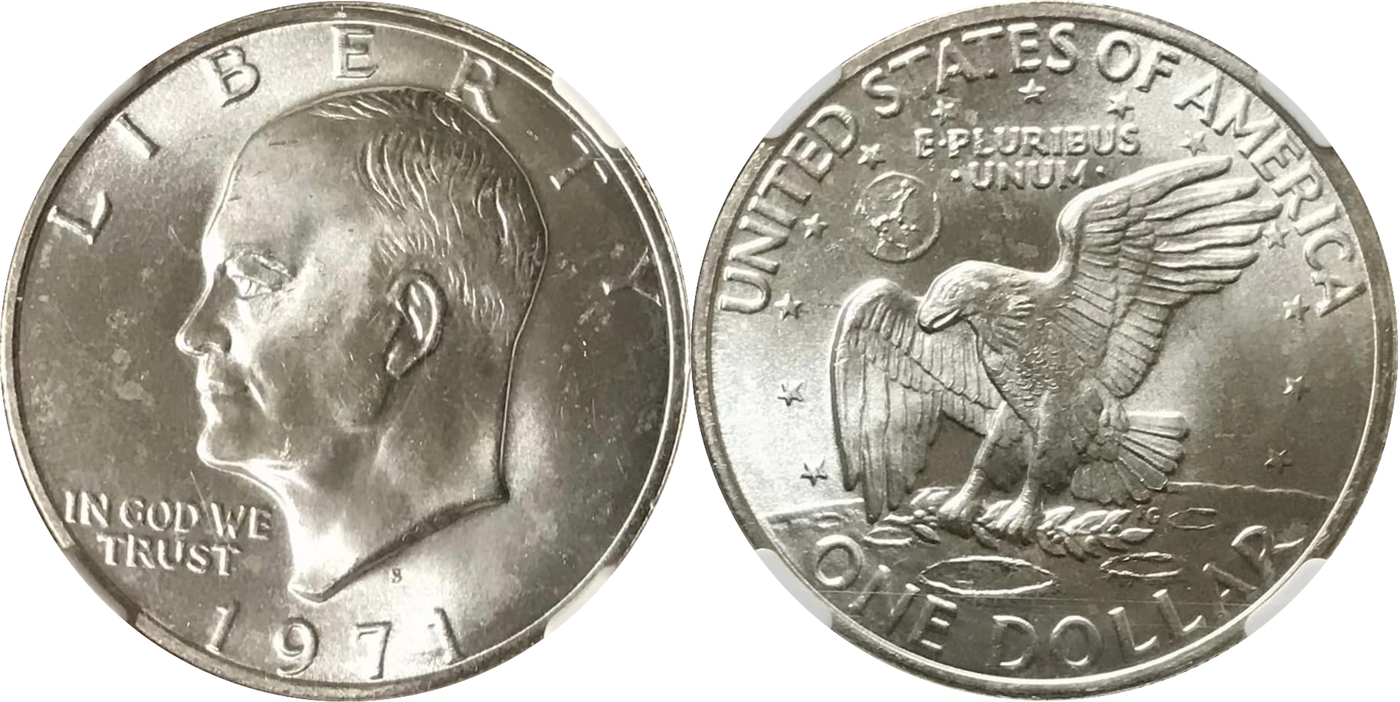
An eagle settling onto the lunar surface — and a dollar most Americans left in a drawer.

The Eisenhower Dollar: a president, the Moon, and a coin too big to spend
Windrain (own work), via Wikimedia Commons (CC0) · CC0 · source

In 1971 the U.S. Mint struck its first dollar coin in 36 years and put two American giants on it at once: a five-star general turned president, and the eagle that had just carried men to the Moon. Then almost nobody used it.

The story behind the coin

In the spring of 1969 the United States lost a president and reached the Moon within a few months of each other. Dwight D. Eisenhower — Supreme Allied Commander in Europe, then two-term president — died on March 28. On July 20, Apollo 11's lunar module Eagle touched down in the Sea of Tranquility. Congress decided one coin should carry both.

The result was the Eisenhower dollar, the first dollar coin the Mint had struck since the Peace dollar ended in 1935. Getting it made took a fight. Lawmakers argued for months over whether the new coin should contain silver at all — the country had just pulled silver out of everyday coinage in 1965. The compromise, signed by President Nixon on December 31, 1970, was clever: ordinary dollars for circulation would be plain copper-nickel, while a run of 40%-silver pieces would be sold to collectors who still wanted precious metal in their hands.

Here is the twist that makes the Ike fascinating. As a coin to spend, it was a flop. At over an inch and a half across and roughly 22.7 grams, it was big, heavy, and awkward — Americans didn't want it jingling in a pocket. A 1976 Treasury study found a near-total attrition rate: the coins simply left circulation. Where they did circulate was Nevada, where the new dollar quickly replaced the casino tokens at the slot machines. By one estimate, over 70% of Eisenhower dollars that actually moved did so across a casino floor.

The design and who made it

The obverse — the heads side — shows Eisenhower in left profile, lean and severe. It was the work of Frank Gasparro, the Mint's tenth Chief Engraver, who said the portrait came from memory: he had stood in a crowd of cheering New Yorkers welcoming the victorious general home after World War II, and never forgot the strength he saw in the man's face.

The reverse is the part that still stops people. An amendment to the coinage bill required the back to honor Apollo 11, and Gasparro answered with a bald eagle descending toward the Moon, an olive branch clutched in its talons, the cratered surface beneath it and a small Earth rising in the distance. He drew it straight from the Apollo 11 mission patch. It is one of the few coins in the world to depict another world.

For the nation's 200th birthday the reverse changed. There were no 1975-dated dollars at all; instead, every dollar struck in 1975 and 1976 carried the dual date 1776–1976 and a new back: the Liberty Bell superimposed on the Moon. That design came from Dennis R. Williams, a sculpture student in his early twenties at the Columbus College of Art and Design, who won a national Bicentennial design competition and a $5,000 prize for it. Gasparro tidied the design for striking. It made Williams one of the youngest people ever to design a circulating U.S. coin.

Key facts

Years struck
1971–1978 (no 1975-dated coins; 1975–76 dated 1776–1976)
Denomination
One dollar
Obverse & standard reverse
Frank Gasparro
Bicentennial reverse
Dennis R. Williams (Liberty Bell over the Moon)
Circulation composition
Copper-nickel clad — 75% copper / 25% nickel outer layers over a pure copper core (~22.68 g)
Silver collector composition
40% silver clad — 80% silver outer layers over a 20.9% silver center (~24.62 g, ~0.3162 oz silver)
Mints / mint marks
Philadelphia (no mark), Denver (D), San Francisco (S); mark on the obverse below the bust
Diameter
38.1 mm (about 1.5 inches)

Collecting it

For a coin that circulated badly, the Ike is a wonderful series to collect — short, affordable to start, and full of small puzzles that reward a sharp eye.

The silver collector issues are the gateway. From 1971 through 1974, and again for the Bicentennial, San Francisco struck 40%-silver dollars sold straight to the public. Uncirculated pieces came sealed in blue envelopes — collectors call them "Blue Ikes" — and mirror-finish proofs came in brown boxes with a gold eagle seal, the "Brown Ikes." The nicknames are still how people talk about them.

Then come the varieties, where the real chase lives. The 1972 Philadelphia dollars exist in three reverse types, told apart by how the Earth above the eagle is drawn — most clearly by the islands beneath Florida. The 1972 Type 2, with its high-relief, near-blank globe, is the scarce one: it is believed to have come from a single reverse die, and a top-grade example has brought five figures at auction. The 1971-S "Peg Leg" is another favorite — on it, the "R" in LIBERTY lost its serifs, leaving the letter looking like it stands on a single leg. Doubled-die varieties exist too.

The crown jewel is almost unreachable. A single 1976 No-S Type 2 proof — a Bicentennial proof dollar that left San Francisco without its mint mark — is the only one known, discovered in a Washington-area department store in 1977. It sits on PCGS's list of the top 100 modern U.S. coins and has been valued in the seven figures. You will probably never own it. Knowing it exists is part of the fun.

Why are top grades scarce at all for such a recent coin? Because these big dollars took a beating. They were stacked, bagged, run through casino cashiers, and rarely babied. A flawless, fully struck Ike with no contact marks — especially on the broad, exposed fields around Eisenhower's cheek — is far harder to find than the huge mintages suggest.

Questions collectors ask

Is my Eisenhower dollar silver?

Most are not. The dollars made for everyday spending are copper-nickel clad — no silver at all. Only the special collector versions struck at San Francisco (1971–1974 and the Bicentennial) are 40% silver, and they carry an S mint mark. A quick tell: silver Ikes have a solid edge, while clad Ikes show a copper stripe on the rim.

Why is there no 1975 Eisenhower dollar?

There isn't one. For the nation's bicentennial, the Mint skipped the 1975 date entirely and struck every 1975- and 1976-produced dollar with the dual date 1776–1976 and the Liberty Bell-and-Moon reverse.

What's the difference between a 1972 Type 1, Type 2, and Type 3?

All three are 1972 Philadelphia dollars; they differ on the reverse, in how the Earth above the eagle is engraved. The Type 2 has a high-relief, nearly featureless globe with no distinct islands below Florida and is by far the scarcest — collectors check 1972 Philadelphia coins specifically hoping to find it.

What is the 1976 No-S Eisenhower dollar worth?

The unique 1976 No-S Type 2 proof — the only known Bicentennial proof dollar that left San Francisco with no mint mark — has been valued in the seven figures and is considered one of the rarest modern U.S. coins. It is a one-of-a-kind rarity, not something to expect in pocket change.

Why didn't the Eisenhower dollar catch on?

It was simply too big and heavy for daily use. Americans wouldn't carry it, and a 1976 Treasury study found almost all of them left circulation. Its real home became Nevada casinos. The lesson pushed the Mint toward the much smaller Susan B. Anthony dollar in 1979.

Sources