US coin · series

The $10 Gold Eagle

Three faces of America's ten-dollar gold piece — coronet, war bonnet, and bullion — across nearly two centuries.

The $10 Gold Eagle
US Mint (coin); photograph by Jaclyn Nash, National Numismatic Collection, National Museum of American History · public domain · source

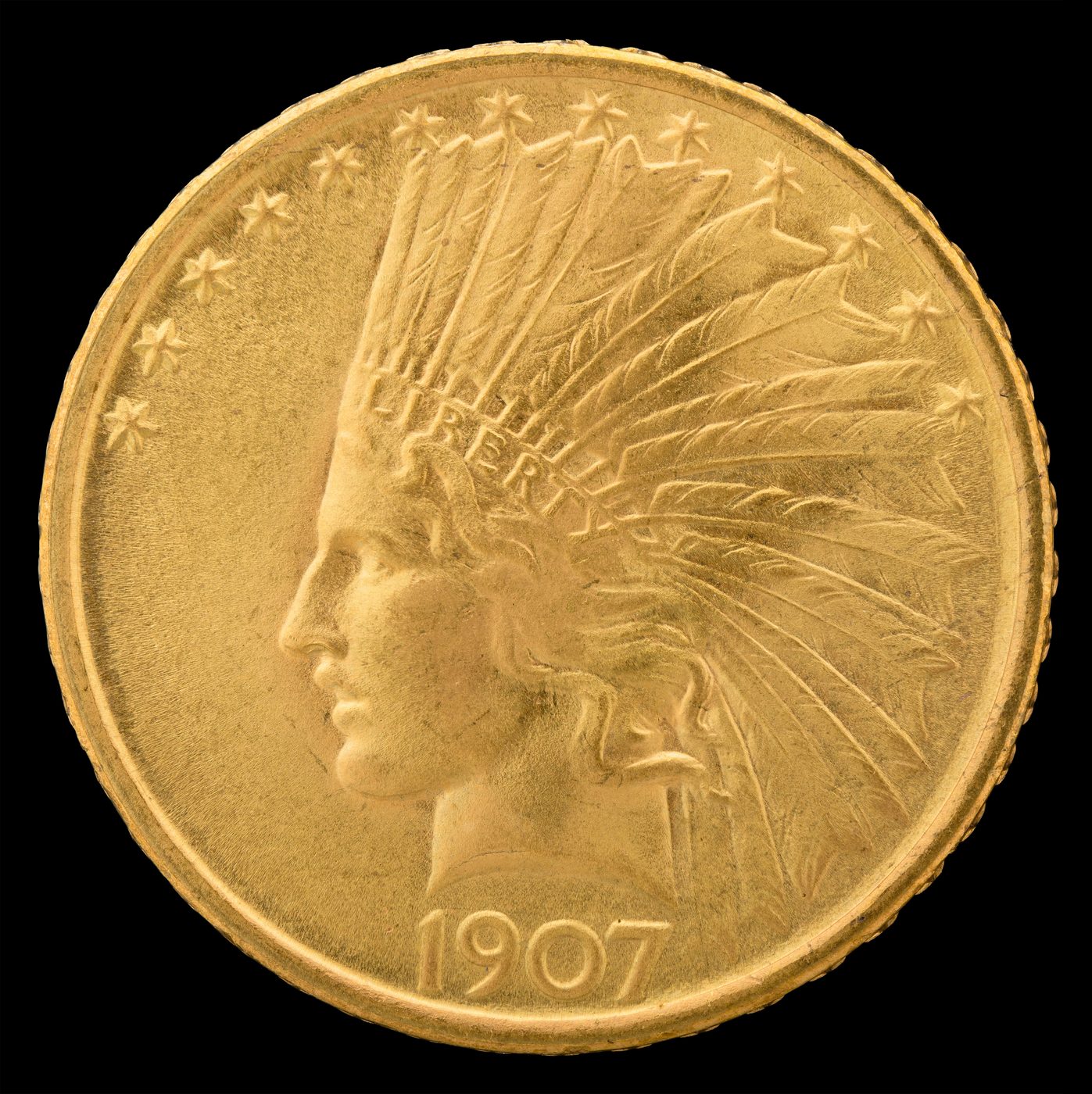
In 1907, a sculptor dying of cancer and a president who hated dull money put a Native American war bonnet on Liberty's head and struck it in gold. That coin was an Eagle — the $10 piece that had already carried American gold for seventy years and would carry it again, reborn, into the modern bullion age.

The story behind the coin

"Eagle" was not a nickname. When Congress wrote the Coinage Act of 1792, it named the new ten-dollar gold piece the Eagle outright — and made it the yardstick for the whole gold family. The quarter eagle was $2.50, the half eagle $5, the double eagle $20. The Eagle was the unit they all answered to.

The Eagle nearly didn't survive its first decades. After 1804 the Mint stopped striking it — the gold in a $10 coin was worth more than $10, so the coins sailed overseas to be melted. For thirty-four years there was no Eagle at all. It came back in 1838, and from then on its story runs in three distinct lives, separated by the day America walked away from gold and the day it came back.

That middle break is the drama. On April 5, 1933, in the depths of the Depression, Executive Order 6102 ordered Americans to turn in their gold coins. The Mint had already struck 1933-dated Eagles — but almost the entire run was melted into bars before it could circulate. The coin existed and then, by order of the government, mostly ceased to. Fewer than forty 1933 Eagles are thought to survive. Unlike the infamous 1933 double eagle, these were legally released, so collectors can actually own one — if they can find it.

The design — three artists, one denomination

The Eagle wears three faces, and each tells you what its era wanted gold to mean.

The Coronet, or Liberty Head (1838–1907). Engraver Christian Gobrecht designed both sides — the obverse (the heads side) and the reverse (tails). His Liberty faces left in a coronet — a small crown — banded with the word LIBERTY, with thirteen stars for the original colonies. He modeled her after the figure of Venus in Benjamin West's 1809 painting Omnia Vincit Amor. The reverse carries a heraldic eagle clutching arrows and an olive branch: the nation ready for war, hoping for peace. Gobrecht reworked Liberty's head in 1839, and in 1866 — after the Civil War shook the country's faith — Chief Engraver James Barton Longacre added the motto IN GOD WE TRUST on a scroll above the eagle. That motto split the Coronet series into two collectible halves: "No Motto" and "With Motto."

The Indian Head (1907–1933). This is the famous one. President Theodore Roosevelt thought American coinage was ugly and said so. He turned to the sculptor Augustus Saint-Gaudens — the finest of his generation — for a redesign Roosevelt called his "pet crime." Saint-Gaudens designed both sides. His Liberty wears a Native American feathered war bonnet (a fusion no real person ever wore — that was the point, an American idea rather than a portrait). The reverse shows a standing eagle on a sheaf of arrows, wrapped in an olive branch — lean, modern, alive. Saint-Gaudens was dying as he finished it; the coin reached the public months after his death in 1907. Roosevelt, who thought religious mottoes on money were close to blasphemy, left IN GOD WE TRUST off the first issues. Public outcry brought it back in 1908, placed on the reverse by Chief Engraver Charles Barber.

The American Gold Eagle (1986–present). When the U.S. returned to gold coinage — this time as bullion, not money you'd spend — the Gold Bullion Coin Act of 1985 brought the Eagle back. The obverse revives Saint-Gaudens again, lifting his striding Liberty from the $20 double eagle. The original reverse (1986–2021) was a new design by sculptor Miley Busiek (later Miley Busiek Frost): a male eagle bringing an olive branch to a nest where a female eagle guards two eaglets — what she called a tribute to the American family. In 2021 the reverse was redrawn by Jennie Norris as a tight portrait of an eagle's head, meant to "capture the intensity of his stare."

Key facts

Denomination
$10 (the Eagle)
Coronet / Liberty Head
1838–1907 — Christian Gobrecht (obverse & reverse)
Indian Head
1907–1933 — Augustus Saint-Gaudens (obverse & reverse)
American Gold Eagle (bullion)
1986–present — Saint-Gaudens obverse; Busiek (1986–2021) / Norris (2021–) reverse
Classic composition
90% gold, 10% copper
Indian Head specs
16.718 g; 0.48375 troy oz gold; 26.92 mm
Bullion composition
22-karat 'crown gold' — 91.67% gold, 3% silver, 5.33% copper
Bullion sizes
$5 (1/10 oz), $10 (1/4 oz), $25 (1/2 oz), $50 (1 oz)
Motto added (Coronet)
IN GOD WE TRUST, 1866 (Longacre)
Famous rarity
1933 Indian Head — nearly the whole run melted; under ~40 survive

Collecting it: key dates, varieties, and scarcity

The Eagle is really three collecting worlds, and the chase is different in each.

The 1907 first-year varieties are the Indian Head's crown jewels. The very first pieces were struck on a medal press with a thin "wire rim" and no raised border — roughly 500 made. Next came a "rounded rim" version, about 32,000 struck, but nearly all were melted; only about 50 are believed to survive. Both are blue-chip rarities. Regular 1907 issues also lack the small triangular periods around TEN DOLLARS, another collector distinction.

The Depression-era dates are where the real money lives. The 1933 is expensive in every grade — almost the entire mintage of 312,500 was destroyed before release. The 1920-S and 1930-S from San Francisco are punishing to find in high grade, and the 1911-D from Denver had the lowest regular mintage of the series at 30,100. These are dates where condition and survival, not just rarity on paper, drive the price.

Why high grades are scarce is the same story for all classic gold: it was money. Eagles circulated, sat in bank vaults, jingled in pockets, and got shipped abroad. A coin that spent decades in commerce shows it. Truly pristine, fully-struck examples — the ones graders call gem — survived by luck, not by design, which is exactly why a common date in extraordinary condition can outprice a rare date that's merely worn.

The modern bullion Eagles trade mostly on their gold content, but collectors still chase low-mintage proof issues, burnished "W" pieces, first-year 1986 coins, and the 2021 transition year — when the reverse switched from Busiek's family of eagles (Type 1) to Norris's eagle portrait (Type 2). Owning both 2021 types is a small, satisfying chase in itself.

Questions collectors ask

Why is the coin called an 'Eagle' if it's worth ten dollars?

Because Congress named it that. The Coinage Act of 1792 christened the $10 gold piece 'the Eagle' and built the rest of the gold coins around it — the half eagle was $5, the quarter eagle $2.50, the double eagle $20. The eagle on the reverse is the design; the Eagle is the denomination.

Who designed the $10 gold Eagle?

Three principal artists across its life. Christian Gobrecht designed the Coronet (Liberty Head) Eagle of 1838–1907, both sides. Augustus Saint-Gaudens designed the Indian Head Eagle of 1907–1933, both sides, at Theodore Roosevelt's request. The modern American Gold Eagle reuses Saint-Gaudens' Liberty on the obverse, with reverses by Miley Busiek (1986–2021) and Jennie Norris (2021 onward).

Can I legally own a 1933 ten-dollar Eagle?

Yes. Unlike the 1933 double eagle — which the government maintains was never legally released — surviving 1933 Eagles were sold from the Mint before Executive Order 6102 took hold, so their ownership has never been challenged. The catch is finding one: only around forty are believed to exist.

Is the Indian Head Eagle actually a portrait of a Native American?

No. Saint-Gaudens used a classical Liberty and, at Roosevelt's insistence, crowned her with a feathered war bonnet — a combination no real person ever wore. It was meant as an American symbol, not a likeness of any individual.

What's the difference between a classic gold Eagle and a modern American Gold Eagle?

The classic Eagles (1838–1933) were spendable money: 90% gold, struck for circulation. The modern American Gold Eagle (1986–present) is a bullion coin authorized by the Gold Bullion Coin Act of 1985 — 22-karat 'crown gold,' sold in four sizes by weight, made to be owned rather than spent.

Sources