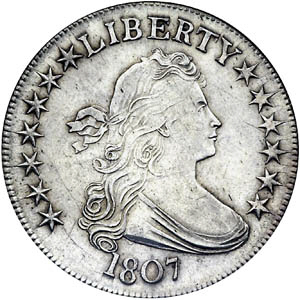
US coin · series

The Draped Bust Half Dollar: America's Rarest Silver Type

A coin so scarce in its first two years that fewer were struck than a small town's population.

The Draped Bust Half Dollar: America's Rarest Silver Type
Unknown author (no photographer credit on the Commons file page; coin designed by Robert Scot) · public domain · source

In 1796 and 1797 the young Philadelphia Mint struck just 3,918 half dollars — combined, across both years. That single fact makes the early Draped Bust half the most coveted silver type coin in all of American numismatics.

The story behind the coin

In the 1790s, the United States Mint had a money problem of its own making. People who brought silver to be coined got to say what they wanted back — and almost everyone wanted dollars. The big, impressive silver dollar was the coin of commerce and the coin of prestige. Hardly anyone asked for half dollars.

So the Mint barely made any. Across all of 1796 and 1797 combined, it struck just 3,918 half dollars. To put that in plain terms: a single modern coin press would produce that many in well under a minute. These were made by hand, on a screw press, one strike at a time — and only when someone specifically requested the denomination.

That scarcity is the whole story. The Draped Bust half dollar of 1796–1797 is widely regarded as the rarest circulation-strike U.S. silver type coin — rarer even than the famous 1796 quarter. Fewer than 300 are thought to survive today, most of them worn smooth from the few decades they did circulate. When one appears at auction, the early-American coin world stops to watch.

This was the dawn of American money. The Mint had opened in Philadelphia in 1792, the first federal building erected under the new Constitution. The men cutting these dies were inventing what United States coinage would look like, denomination by denomination, with no tradition to lean on. The half dollar got its turn in 1796 — and almost no one wanted it.

The design and who made it

The face of the coin is called the Draped Bust — Liberty shown from the chest up, her hair flowing back and tied with a ribbon, a length of cloth draped across her shoulder. It replaced the earlier "Flowing Hair" design, which critics had mocked as wild and undignified. The new portrait was meant to look refined, even aristocratic.

The portrait's origin is one of numismatics' best-loved stories — and one worth telling carefully. The drawing is traditionally credited to the celebrated portraitist Gilbert Stuart (the man who painted the George Washington image on the dollar bill), reportedly modeled on the Philadelphia socialite Ann Willing Bingham. A Rhode Island artist, John Eckstein, is said to have rendered Stuart's sketch into a plaster model. Then the Mint's Chief Engraver, Robert Scot, cut the working dies. Some scholars doubt how much Stuart was really involved; if he wasn't, the design falls to Scot and Eckstein. Either way, the engraving — the actual coin — is Robert Scot's work. (The obverse is the "heads" side; the reverse is "tails.")

The reverse changed dramatically over the type's life, which is why collectors talk about it as two coins in one:

  • Small Eagle (1796–1797). A slight, natural-looking eagle perched within an open wreath. Graceful, but contemporaries thought it looked scrawny.
  • Heraldic Eagle (1801–1807). A bold, official eagle adapted from the Great Seal of the United States — wings spread, a shield on its breast, an olive branch in one claw and a bundle of arrows in the other, a ribbon reading E PLURIBUS UNUM in its beak, and an arc of stars and clouds above. It was the new nation flexing its symbols.

A telling detail of the early years: the number of stars. The 1796 obverse exists with both 15 stars and 16 stars — the extra star added when Tennessee joined the Union in 1796. The 1797 coins, oddly, reverted to 15 stars, almost certainly because the Mint was using an obverse die prepared the year before.

Key facts

Years struck
1796–1797 (Small Eagle), 1801–1807 (Heraldic Eagle); none dated 1798–1800
Designer / engraver
Robert Scot (dies), after a drawing attributed to Gilbert Stuart; modeled by John Eckstein
Composition
89.24% silver, 10.76% copper (.8924 fine)
Weight
~13.48 g (208 grains)
Diameter
~32.5 mm
Edge
Lettered: FIFTY CENTS OR HALF A DOLLAR
Small Eagle total (1796–97)
3,918 struck — the rarest U.S. silver type coin
Famous variety
1806/5 overdate (Heraldic Eagle)
Highest mintage year
1806 — 839,576
Lowest Heraldic mintage
1802 — 29,890

Collecting it: key dates, varieties, and why high grades are scarce

Questions collectors ask

Why is the 1796–1797 Draped Bust half dollar so rare and valuable?

Only 3,918 were struck across both years combined. In the 1790s, people who deposited silver at the Mint chose what they got back, and almost everyone wanted dollars — so half dollars were made only on specific request. With so few struck and even fewer saved, it is considered the rarest circulation-strike U.S. silver type coin, with fewer than 300 thought to survive.

What's the difference between the Small Eagle and Heraldic Eagle reverses?

The Small Eagle (1796–1797) shows a slender, natural eagle inside a wreath. The Heraldic Eagle (1801–1807) shows a bold official eagle adapted from the Great Seal — shield on its breast, olive branch and arrows in its claws, E PLURIBUS UNUM on a ribbon, and stars and clouds above. The same Draped Bust portrait appears on the front of both.

Why are there no 1798, 1799, 1800, or 1804 Draped Bust half dollars?

The Mint struck no half dollars at all from 1798 through 1800 — demand stayed with silver dollars. It also struck none dated 1804, even though dies appear to have been prepared (the 1805/4 overdate is the evidence). Production of the half dollar ran 1796–1797, then resumed in 1801 and continued through 1807.

Who really designed the Draped Bust?

The portrait is traditionally credited to artist Gilbert Stuart, reportedly modeling Ann Willing Bingham, with a plaster model by John Eckstein. Some scholars question how much Stuart was involved. What is certain is that Chief Engraver Robert Scot cut the actual dies, and the Heraldic Eagle reverse was his work after the Great Seal.

What is the 1806/5 half dollar?

It's an overdate — a die originally dated 1805 that the Mint re-engraved to read 1806, leaving traces of the underlying 5 visible inside the 6. It's the most famous variety of the type and a favorite target for collectors of Overton die marriages.

Sources

Draped Bust Half Dollar (1796–1807) | colcur | colcur