US coin · series

The 1987 Constitution $5 Gold — an Eagle That Traded Its Arrows for a Pen

A bicentennial gold coin whose surcharges went straight to paying down the national debt.

The 1987 Constitution $5 Gold — an Eagle That Traded Its Arrows for a Pen
U.S. Mint (www.usmint.gov), U.S. Department of the Treasury · public domain · source

In 1987, the U.S. Mint struck a small gold coin that did something most coins never do: it tried to shrink the national debt. Every buyer paid a $35 surcharge written into law for that single purpose — and the eagle on the front held not a clutch of arrows, but a writer's quill.

The story behind the coin

September 17, 1987 marked two hundred years since thirty-nine men signed the U.S. Constitution in Philadelphia. Congress wanted the anniversary marked in metal — and it wanted the coins to do something useful while they were at it.

The Bicentennial of the Constitution Coins and Medals Act (Public Law 99-582), signed into law on October 29, 1986, authorized two coins: a silver dollar and this $5 gold piece — a "half eagle," the traditional name for the United States' five-dollar gold denomination. The law capped the gold coin at one million pieces and attached a $35 surcharge to every one sold.

Here is the unusual part. That surcharge was earmarked, by statute, for the general fund of the Treasury for the sole purpose of reducing the national debt. Most commemorative coins raise money for a museum, a memorial, or an organizing committee. This one was sold, in part, to chip away at what the country owed. It is a rare case of a coin with a fiscal mission baked into the law that created it.

The program was a single-year affair — struck only in 1987, never repeated — and it sold briskly. Across both the silver dollar and this gold half eagle, the Constitution program moved millions of coins and sent tens of millions of dollars in surcharges toward the debt. For a modern commemorative, that was a genuine success.

The design

The Mint did not simply hand the job to its own engravers. It ran a competition — eleven outside artists and six Mint sculptors, each paid $1,000 to submit designs. On March 31, 1987, Treasury Secretary James A. Baker III announced the winner: Marcel Jovine, an Italian-born American sculptor and toy designer who had already shaped the 1984 Olympic eagle.

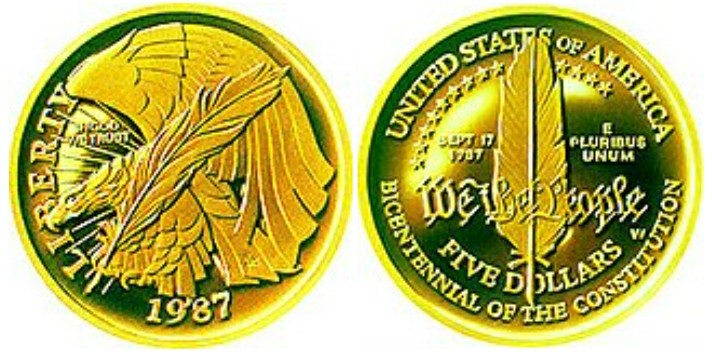
Jovine's coin is modern and spare, and that was the point. The obverse — the "heads" side — shows a linear, highly stylized flying eagle gripping a quill pen in its talons. It is a deliberate inversion of the usual American eagle, which clutches arrows for war and an olive branch for peace. Here the eagle carries the instrument that wrote the founding document. The message is hard to miss: this nation was built with a pen, not a sword.

The reverse — the "tails" side — sets a single quill pen upright, with the Constitution's opening words, "We the People," rendered in calligraphy across the lower field. Flanking the design are thirteen stars: nine on one side for the states needed to ratify the Constitution and bring it into force, and four for the remaining original states. The whole composition is clean, almost graphic — closer to a 1980s logo than to the dense classical relief of older U.S. gold.

The coin was struck at the West Point Mint in New York, which is why it carries a "W" mint mark — the small letter that tells you which facility made a coin. It was offered in two finishes: a mirror-like proof (struck on polished dies with frosted devices, made for collectors) and a satiny uncirculated version.

Key facts

Year struck
1987 only
Denomination
$5 gold (half eagle)
Designer
Marcel Jovine (obverse and reverse)
Mint
West Point (mint mark W)
Composition
90% gold, 10% alloy (silver and copper)
Weight
8.359 g (0.2419 troy oz actual gold weight)
Diameter
21.59 mm
Edge
Reeded
Proof mintage
651,659
Uncirculated mintage
214,225
Surcharge
$35 per coin, for national-debt reduction
Authorizing law
Public Law 99-582 (Oct. 29, 1986)

Collecting it

This is an accessible coin, and that is its appeal for a first gold purchase. With more than 650,000 proofs and over 214,000 uncirculated pieces made, neither version is rare in an absolute sense — you can find both without a hunt. The proof outsold the uncirculated by about three to one, so ironically the uncirculated (mint-state) coin is the scarcer of the two, a quirk worth knowing.

Because so many were sold to collectors and tucked away in their original Mint packaging, most survive in high grade. That shifts the game from "can I find one" to "how good is the one I find." The premium coins are the technically flawless ones — a flawless proof graded PR70 DCAM (deep cameo: a sharp frosted design floating over a black-mirror field, with no detectable flaws) or a pristine MS70 uncirculated piece. Below that ceiling, the coin trades largely on its gold content, since each holds just under a quarter ounce of gold.

For a newcomer, the smart move is to understand what you are paying for: a near-perfect graded example carries a real collector premium, while a typical certified piece is mostly a small, attractive way to own a piece of gold tied to a genuine national milestone.

Questions collectors ask

What does the 'W' mint mark on the 1987 Constitution $5 gold mean?

The W marks the West Point Mint in New York, where every Constitution half eagle was struck. West Point handled much of the Mint's gold and commemorative work in this era.

How much gold is in the 1987 Constitution $5 coin?

The coin is 90% gold and weighs 8.359 grams, which works out to 0.2419 troy ounces of actual gold — just under a quarter ounce. The rest of the weight is a silver-and-copper alloy for durability.

Is the proof or the uncirculated version rarer?

The uncirculated (mint-state) coin is scarcer. The Mint sold 651,659 proofs but only 214,225 uncirculated pieces, so the brilliant-finish version is the harder of the two to find — the opposite of what many buyers assume.

Why did this coin have a $35 surcharge?

The law that authorized it (Public Law 99-582) required a $35 surcharge on every gold coin sold, with the money sent to the Treasury's general fund specifically to reduce the national debt. The silver dollar carried a $7 surcharge for the same purpose.

Why is the eagle holding a pen instead of arrows?

It is a deliberate symbol. The U.S. eagle usually clutches arrows and an olive branch — war and peace. Designer Marcel Jovine gave this eagle a quill pen instead, to honor the Constitution as a document written, not won by force.

Sources