US coin · series

The Cleveland / Great Lakes Exposition Half Dollar

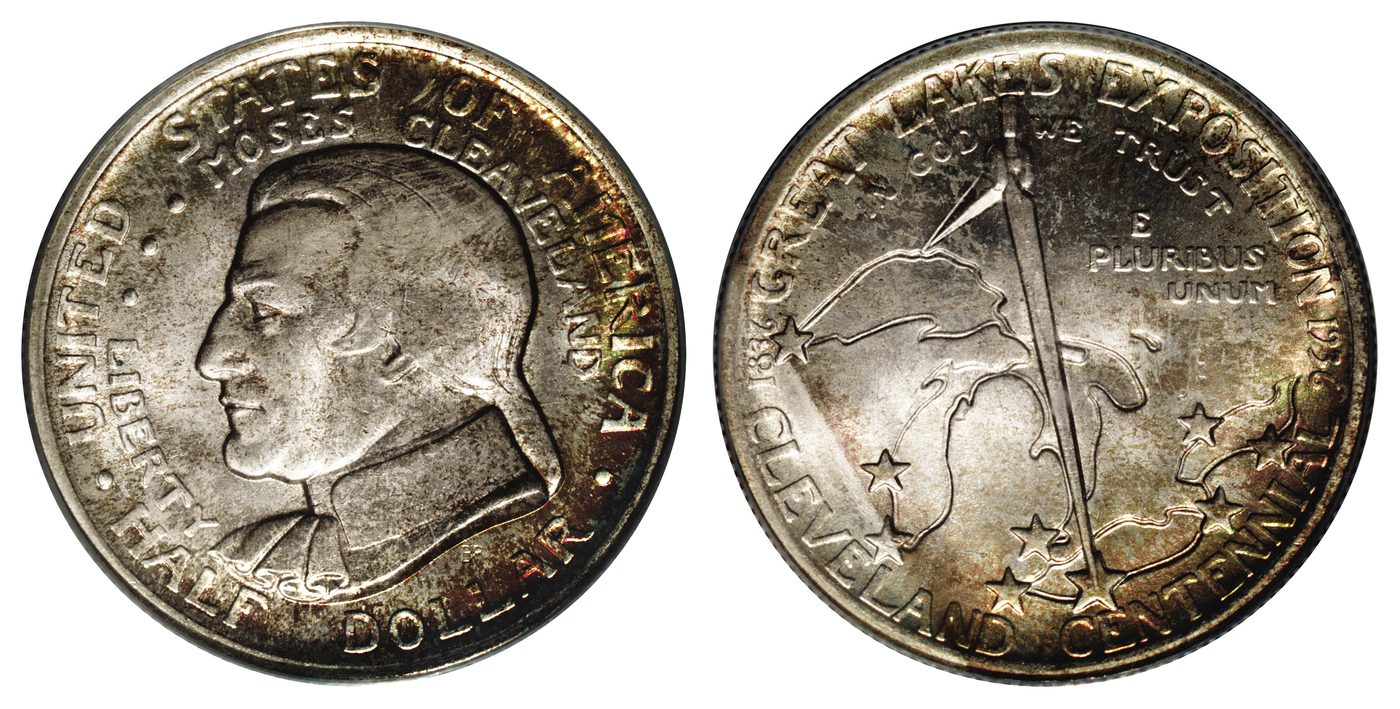
The 1936 commemorative Congress wrote rules around — one date, one mint, one design, by law.

The Cleveland / Great Lakes Exposition Half Dollar
U.S. Mint (coin); Heritage Auctions (image), Lot 7319, January 2006 · public domain · source

In 1936 the United States was minting commemorative half dollars faster than anyone could collect them — and a few promoters were getting rich off it. The Cleveland half dollar is the one Congress used to put a stop to it.

The coin that came with rules

By the spring of 1936, the American commemorative coin program had gone off the rails. Congress had authorized a flood of special half dollars, and a handful of promoters had figured out how to milk them — striking the same coin at several mints in successive years, inventing "anniversaries," and keeping mintages low so collectors had to pay up for every variety. Coins meant to honor history had become a private money machine.

The man at the center of it was Thomas G. Melish, a Cincinnati businessman and collector. He had just made a tidy profit on the 1936 Cincinnati Musical Center half dollar — a coin marking, as the Senate later noted, an anniversary that didn't actually exist. So when Melish helped push a half dollar for Cleveland's centennial through Congress, lawmakers were watching.

The Senate Banking Committee, chaired by Alva B. Adams of Colorado, held hearings that March documenting the abuses point by point. Then it wrote the fix directly into the Cleveland coin's authorizing act, signed by President Franklin Roosevelt on May 5, 1936. The Cleveland half dollar had to be a single design, struck at a single mint, dated 1936 no matter what year it was actually made, and ordered in lots of no fewer than 25,000. The era of the manufactured variety was, on paper, over. That is the Cleveland half dollar's real claim to fame — not what it depicts, but what it stopped.

What it shows — and who made it

The coin honored two things at once: the 100th anniversary of Cleveland's incorporation as a city in 1836, and the Great Lakes Exposition, a 150-acre world's-fair-style spectacle on the Lake Erie shore that drew roughly four million visitors between June and October of 1936.

The designer was Brenda Putnam, a respected American sculptor and the daughter of the Librarian of Congress. On the obverse — the heads side — she placed a portrait of Moses Cleaveland, the Connecticut surveyor who laid out the townsite in 1796 and gave it his name. (The spelling lost its first "a" in the early 1830s, the story goes, so the name would fit a newspaper masthead — a detail collectors love to repeat.) Putnam worked from the only known likeness of Cleaveland, a portrait by an unknown hand.

The reverse is the more inventive side. Rather than sketch buildings, Putnam mapped the Great Lakes region and marked nine cities as stars — Duluth, Milwaukee, Chicago, Toledo, Detroit, Cleveland, Toronto, Buffalo, Rochester — with Cleveland's star enlarged and pierced by the point of a compass. The idea of using stars instead of skylines came from sculptor Lee Lawrie, advising for the Commission of Fine Arts. Critics have been split ever since: one early reviewer called the design "pleasing… sharply defined, interesting and not crowded," while the art historian Cornelius Vermeule later found the compass-bisected map "incomprehensible." Putnam, he allowed, was working within severe space constraints.

Key facts

Years struck
1936 and 1937 (all dated 1936)
Mint
Philadelphia (no mint mark)
Designer
Brenda Putnam (obverse and reverse)
Obverse
Moses Cleaveland, founder of the city
Reverse
Great Lakes map; nine cities as stars, compass on Cleveland
Authorizing act
Signed May 5, 1936 by President Franklin Roosevelt
Total mintage
50,030 (50,000 sold + 30 for the Assay Commission)
Composition
90% silver, 10% copper
Weight
12.5 g
Diameter
30.6 mm
Original price
$1.50 per coin
Distributor
Thomas G. Melish, Cleveland Centennial Commemorative Coin Committee

Collecting it

Here is the irony of all that congressional scrutiny: by clamping the Cleveland issue to a single date and mint, Congress made it one of the most available classic commemoratives there is. The full authorized run of 50,000 was struck and sold, and because there are no varieties to chase, demand spread thin. Thousands sat unsold in dealer inventories for years. As late as 1942, Melish reportedly offered a dealer 16,000 of the coins for any premium at all over face value — and was turned down.

For a collector today, that abundance is good news. The Cleveland is one of the easiest "Texas-era" silver commemoratives to find in choice uncirculated grade, and an affordable entry point into the series. The story changes at the very top of the grading scale: a coin's grade measures how well it survived — from worn to flawless gem — and pristine, fully struck examples with original surfaces are genuinely scarce, since most coins were handled as souvenirs rather than preserved. One exceptional piece brought $4,700 at auction in 2014, against typical prices a small fraction of that.

There are no major die varieties to memorize, by design. The one curiosity worth knowing is the counterstamped pieces: in 1941 the Western Reserve Numismatic Club punched its own mark into 100 of these coins for the club's 20th anniversary. The Secret Service viewed defacing U.S. coinage dimly and asked for them back; most owners complied. The handful that survive are a footnote collectors prize.

Questions collectors ask

Who designed the Cleveland Centennial half dollar?

Brenda Putnam, an American sculptor and daughter of the Librarian of Congress, designed both sides. She placed Moses Cleaveland on the obverse and a star-marked map of the Great Lakes on the reverse — the star idea suggested by sculptor Lee Lawrie of the Commission of Fine Arts.

Why are some 1936 Cleveland half dollars dated 1936 if they were struck in 1937?

By law. Congress wrote the authorizing act to forbid the abuses that had plagued other commemoratives — so every Cleveland coin had to carry the 1936 date regardless of when it was actually minted. Roughly half the run was struck in 1937 but still reads 1936.

How many Cleveland half dollars were made?

50,030 in total — the full 50,000 authorized for sale, plus 30 reserved for the annual Assay Commission. All were struck at the Philadelphia Mint, so none carry a mint mark.

Is the Cleveland half dollar rare?

No — it is one of the most common classic U.S. commemoratives, because Congress capped it to one date and one mint with no varieties to chase. Many went unsold for years. The exception is at the highest grades, where well-preserved gem examples are genuinely scarce.

Who was Moses Cleaveland?

A Connecticut surveyor, lawyer, and land-company director who laid out the townsite on Lake Erie in 1796 and gave it his name. He returned to Connecticut and, by most accounts, never came back to Ohio. The town's spelling later lost its first 'a' to become 'Cleveland.'

Sources