US coin · series

The Teacher Who Was Going to Space — On a Silver Dollar

In 2021, exactly 35 years after Challenger, the Mint put Christa McAuliffe's own words on a coin.

The Teacher Who Was Going to Space — On a Silver Dollar
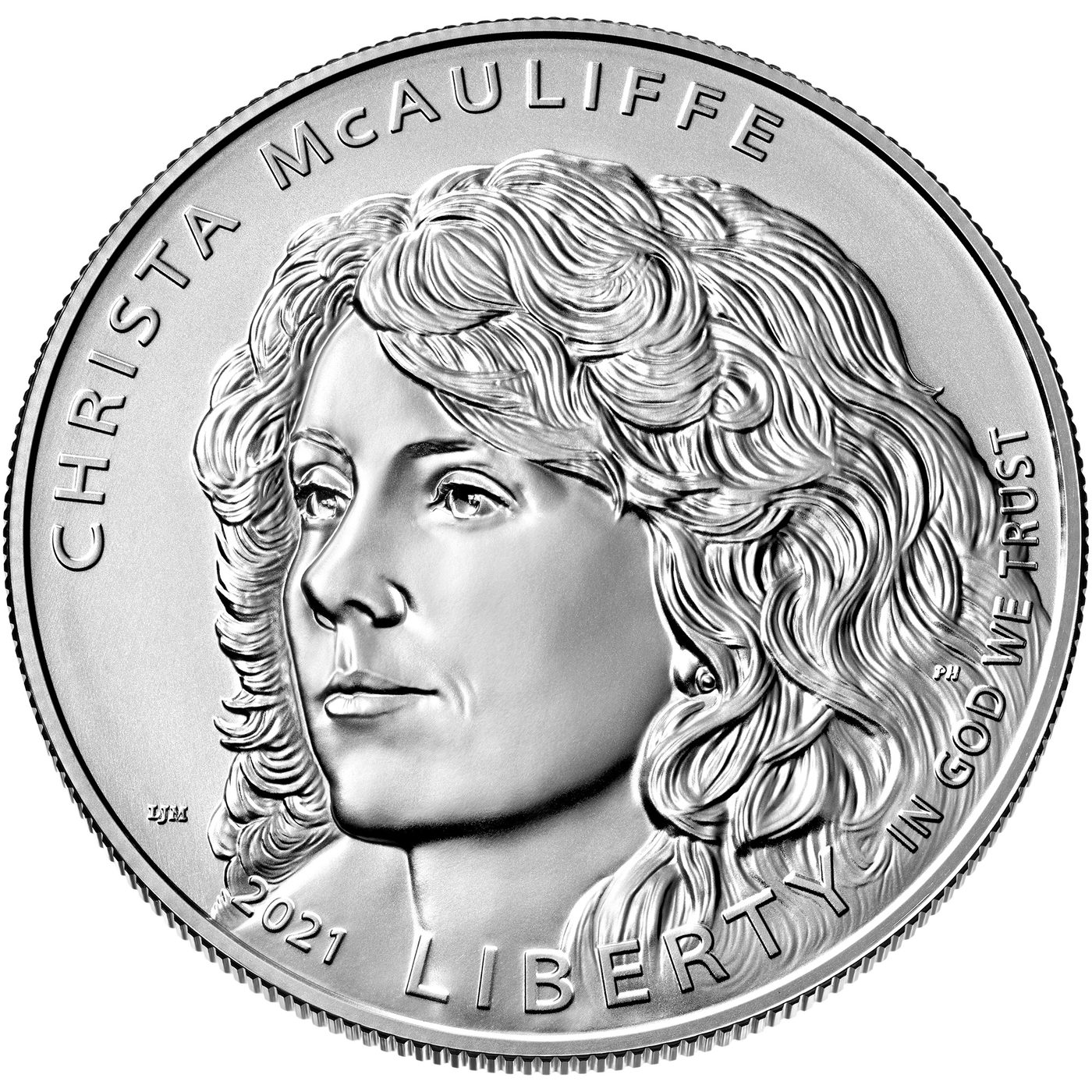
Phebe Hemphill (Sculptor), Laurie Musser (Designer); via U.S. Mint · public domain · source

She was an ordinary social studies teacher from New Hampshire — chosen from more than 11,000 applicants to be the first private citizen in space. She never made it. Thirty-five years to the day after the Challenger broke apart, the U.S. Mint released a silver dollar that carries her face, three students looking up at her, and the line she lived by: "I touch the future. I teach."

The story behind the coin

On January 28, 1986, a high-school social studies teacher named Christa McAuliffe was 73 seconds into the most public minute of her life. She had won a seat aboard the Space Shuttle Challenger out of more than 11,000 applicants to NASA's Teacher in Space program — the first ordinary citizen invited to fly. Classrooms across the country were watching the launch live. Then the shuttle came apart, and McAuliffe and six astronauts were gone.

Thirty-five years later — to the very day — the United States Mint released this coin. The timing was not an accident. Congress had passed the Christa McAuliffe Commemorative Coin Act of 2019 (Public Law 116-65), and the Mint chose January 28, 2021 for the first sale so the anniversary and the tribute would land together.

A commemorative coin is a one-time issue Congress authorizes to mark a person or event. Unlike the cent in your pocket, it never circulates — it's sold once, at a premium, to collectors and to people who simply want to hold the moment. This one had a second purpose built in. Every coin carried a $10 surcharge — a fee added to the price — sent to FIRST, the robotics and STEM program that pushes kids toward science and engineering. The coin didn't just remember a teacher. It funded the next generation she would have taught.

The design

Two artists shaped this dollar. The obverse — the heads side — carries a portrait of McAuliffe, designed by Laurie J. Musser and sculpted by U.S. Mint medallic artist Phebe Hemphill. (To sculpt a coin is to translate a flat drawing into the three-dimensional relief that the dies will strike — the raised and recessed surfaces you feel with a thumbnail.)

The reverse — the tails side — is where the coin tells its story, and it's the work of designer Emily Damstra, sculpted by Chief Engraver Joseph Menna. It doesn't show McAuliffe in a classroom. It shows her outdoors, pointing forward and upward, while three high-school-age students look on. Damstra has said she "decided early in the design process that I would show her engaging a group of students in a non-classroom situation," because her research found that McAuliffe believed deeply in hands-on, experiential learning.

Look closer and the design grieves quietly. Seven stars hang above the figures. They place the scene under an open sky — and, as Damstra put it, they "represent the seven Challenger astronauts who died." Arcing across the top is McAuliffe's own motto: "I TOUCH THE FUTURE. I TEACH." (Collectors and educators have long tied this line to her; whether she first coined it or simply adopted it is uncertain — she famously wore it, and it became hers.)

One more feature makes this coin genuinely unusual: the logo of FIRST, the private nonprofit that receives the surcharge, appears right on the reverse. A named outside organization's mark on a circulating-format U.S. coin is rare — the design was settled only after the Treasury consulted McAuliffe's family, the Commission of Fine Arts, the Citizens Coinage Advisory Committee, and FIRST itself.

Key facts

Denomination
$1 (silver dollar)
Year struck
2021
First sale
January 28, 2021 — the 35th anniversary of the Challenger disaster
Mint
Philadelphia (P mint mark)
Composition
99.9% silver (.999 fine)
Weight / diameter
26.730 g / 38.1 mm, reeded edge
Obverse designer / sculptor
Laurie J. Musser / Phebe Hemphill
Reverse designer / sculptor
Emily Damstra / Joseph Menna
Authorizing act
Christa McAuliffe Commemorative Coin Act of 2019 (Public Law 116-65)
Surcharge
$10 per coin to the FIRST robotics / STEM program
Maximum authorized mintage
350,000 (proof + uncirculated combined)
Final sales
54,191 proof + 16,038 uncirculated (70,229 total, per U.S. Mint)

Collecting it

Here's the quiet surprise of this coin: almost nobody bought it. Congress allowed up to 350,000 — proof and uncirculated combined. Final U.S. Mint sales came to 70,229 in all: roughly 54,200 of the proof version (a mirror-finish coin struck on polished blanks, the collector's piece) and about 16,000 of the uncirculated version (a satin finish). So whatever number the Mint ultimately struck, it lands far below the ceiling — a low-mintage modern dollar by design, not by accident.

That makes the math interesting. The coin holds 99.9% silver — nearly an ounce of metal — so even a common example never falls below its silver value. The collector premium rides on the small print run, the finish, and the grade. The top-grade tier here is the gem: a proof graded PR70 (or an uncirculated MS70) means flawless under magnification, and the gap in price between a 69 and a 70 can be substantial. Watch, too, for special holder labels and signed pieces tied to the program — they're marketing, not metal, and the premium reflects demand rather than rarity.

For a newcomer, the appeal is simpler than any of that. This is a coin you can buy graded and slabbed, hold in one hand, and read aloud. The story is right there on the silver.

Questions collectors ask

Why was the Christa McAuliffe silver dollar released on January 28, 2021?

That date is the 35th anniversary of the Space Shuttle Challenger disaster, January 28, 1986, in which McAuliffe and six astronauts died. The U.S. Mint timed the first sale to fall exactly on the anniversary.

Who designed the coin?

Two teams. The obverse portrait was designed by Laurie J. Musser and sculpted by Phebe Hemphill. The reverse — McAuliffe with three students under seven stars — was designed by Emily Damstra and sculpted by Chief Engraver Joseph Menna.

What does the inscription 'I touch the future. I teach.' mean?

It's the motto long associated with Christa McAuliffe, capturing her belief that teaching shapes what comes next. It arcs across the reverse of the coin. Whether she originated the phrase or adopted it is uncertain, but it became inseparable from her.

Why is the FIRST logo on a U.S. coin?

Every coin carried a $10 surcharge paid to FIRST, the nonprofit STEM and robotics program for young people. Its logo appears on the reverse — an unusual feature for a U.S. coin, included after the Treasury consulted McAuliffe's family, the Commission of Fine Arts, the CCAC, and FIRST.

How rare is the coin?

Congress authorized up to 350,000, but final sales were far lower — 70,229 combined, weighted heavily toward the proof version (about 54,200 proof to 16,000 uncirculated). That makes it a genuinely low-mintage modern commemorative dollar.

Is it real silver?

Yes. It is struck in 99.9% fine silver, weighs 26.730 grams, and measures 38.1 mm across — a full-size silver dollar with close to an ounce of silver in it.

Sources