US coin · series

The Gold Coin That Paid for a Building Nobody Could See

A 2001 half eagle that funded the Capitol's underground visitor center — long before that center existed.

The Gold Coin That Paid for a Building Nobody Could See
United States Mint (www.usmint.gov) · public domain · source

In 2001 the U.S. Mint sold a gold coin to help build a visitor center beneath the U.S. Capitol. The coin came first. The building it paid for did not open until December 2008 — seven years later, and at more than double its budget.

The story behind the coin

In November 1800, Congress met in the United States Capitol for the first time. The building was half-finished and the city around it was raw mud, but the lawmakers came anyway — the new republic's legislature, sitting at last in its own home.

Two centuries later, Congress decided to mark that moment by building something modern: a vast visitor center hidden under the Capitol's East Plaza, so the millions of tourists who arrive each year would have somewhere to gather, learn, and pass through security. The problem was paying for it. So Congress did what it had done for stadiums, museums, and monuments before — it authorized commemorative coins and let collectors foot part of the bill.

The United States Capitol Visitor Center Commemorative Coin Act of 1999 (Public Law 106-126) created three coins: a clad half dollar, a silver dollar, and this — a $5 gold half eagle. Every coin carried a surcharge, a built-in donation baked into the price. For the gold coin it was $35, and every dollar of it flowed into the Capitol Preservation Fund to help build the center.

Here is the twist that gives the coin its character. The coins sold in 2001. The center they funded was estimated at $265 million and meant to open in 2005. After the September 11 attacks, security demands grew, costs ballooned, and the final bill reached about $621 million — more than double the estimate. The 580,000-square-foot center finally opened on December 2, 2008. The little gold coin had been in collectors' cabinets for seven years before anyone walked through the doors it helped pay for.

The design

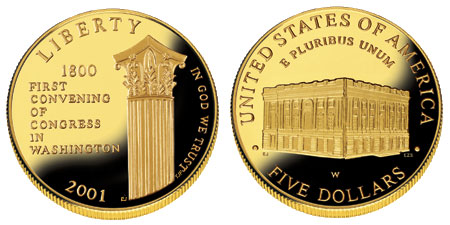
The coin was designed by Elizabeth Jones — and that name matters. Jones was the U.S. Mint's Chief Sculptor-Engraver from 1981 to 1990, the first woman ever to hold the post. By 2001 she was no longer on staff, but the Mint brought her back to shape both sides of this coin. She designed the obverse (the heads side) and the reverse (the tails side) alike.

The obverse shows the top of a Corinthian column — the ornate, leaf-carved column capital that lines the Capitol itself — wrapped with the words "First Convening of Congress in Washington." It is a quiet, classical choice: not the whole building, just the detail that says "this is a temple of government." The reverse shows the Capitol as it actually looked in 1800, low and modest, before the great cast-iron dome that defines it today was even imagined.

That pairing tells the coin's whole idea in two faces. One side is the timeless architecture of the republic; the other is the humble building where it all began. A few words of vocabulary worth knowing: the relief is how high the design stands off the surface, and the strike is the act of pressing the design into the blank metal. On a small, high-purity gold coin like this, a sharp strike and clean fields are what collectors prize.

Key facts

Denomination
$5 (gold half eagle)
Year struck
2001
Mint
West Point (W mint mark)
Designer
Elizabeth Jones (obverse and reverse)
Composition
90% gold, 3.6% silver, 6.4% copper
Weight
8.359 g (0.2419 oz gold)
Diameter
21.59 mm (0.850 in)
Edge
Reeded
Authorizing law
Public Law 106-126 (1999)
Commemorates
First convening of Congress in the Capitol, 1800
Surcharge
$35 per coin → Capitol Preservation Fund
Mintage limit
100,000 authorized
Mintage — Uncirculated
6,761
Mintage — Proof
27,652

Collecting it

This is one of the scarcer modern U.S. gold commemoratives, and the reason is simple: hardly anyone bought it. Congress authorized up to 100,000 gold coins. The Mint sold 6,761 in the uncirculated (business-strike) finish and 27,652 in proof — the mirror-polished collector finish struck on specially prepared blanks. Together that is barely a third of the ceiling, and the uncirculated version in particular is genuinely uncommon.

That low mintage drives the market. The coin carries roughly a quarter-ounce of gold, so it always has a bullion floor that rises and falls with the gold price. But in the highest grades — and especially the harder-to-find uncirculated strike — the price reflects scarcity, not just metal. The proof, with its larger mintage, is the easier and cheaper of the two to find.

For a coin this young, condition is everything, because survivors were mostly tucked away by collectors and rarely circulated. Grades are assigned on the 70-point Sheldon scale; a flawless example earns a 69 or 70, and the gap in value between a near-perfect coin and a perfect one can be steep. The "W" mint mark tells you it was struck at West Point, the Mint facility that handles most modern U.S. gold.

Questions collectors ask

What does the 2001 Capitol Visitor Center $5 gold coin commemorate?

It marks the first time Congress convened in the United States Capitol, in 1800. The reverse shows the Capitol as it looked that year, before its famous cast-iron dome existed.

Who designed the coin?

Elizabeth Jones designed both sides. She was the U.S. Mint's Chief Sculptor-Engraver from 1981 to 1990 and the first woman to hold that office. The Mint brought her back to design this coin after she had left the staff.

How rare is it?

Quite scarce for a modern issue. Congress authorized up to 100,000 gold coins, but the Mint sold only 6,761 uncirculated and 27,652 proof — together about a third of the limit. The uncirculated strike is the harder of the two to find.

Why was the coin made if the visitor center didn't exist yet?

The coins were a fundraising tool. A $35 surcharge on each gold coin went into the Capitol Preservation Fund to help build the center. The coins sold in 2001; the center, beset by post-9/11 security additions and cost overruns, opened in December 2008 at roughly $621 million — more than double its original estimate.

Does the coin contain real gold?

Yes. It is 90% gold and weighs 8.359 grams, holding about a quarter ounce of pure gold — the same standard as a classic U.S. $5 half eagle. That gold content gives the coin a price floor that moves with the gold market.

Sources