US coin · series

The Braided Hair Cent: America's Last Big Copper Penny

A coin the size of a half-dollar — killed off by the price of copper itself.

The Braided Hair Cent: America's Last Big Copper Penny
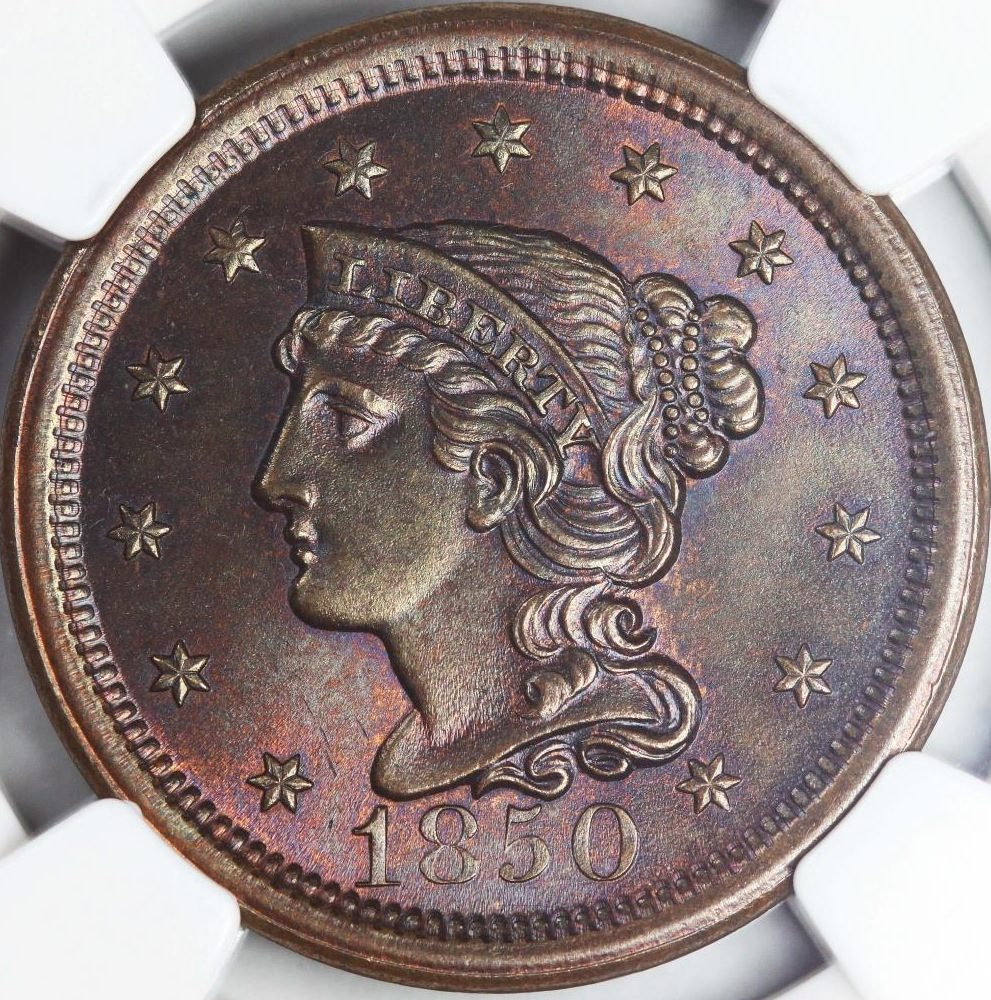
Coin: Christian Gobrecht; image by Lost Dutchman Rare Coins (via Wikimedia Commons) · public domain · source

For its last eighteen years, the United States cent was a hunk of pure copper as wide as a modern half-dollar — too big, too heavy, and by 1857 worth less than the metal in it. This is the coin that ended the era of the big penny.

The story behind the coin

Picture a penny the size of a half-dollar. Pure copper, nearly 11 grams of it, heavy in the hand. For the first 64 years of the United States Mint, that was the cent — the "large cent," a coin Americans hauled around by the fistful. The Braided Hair cent is the last chapter of that story, struck from 1839 to 1857.

It arrived as a fix for an embarrassment. The previous design, the "Matron Head," was so unloved that the great numismatist Walter Breen later called it "a spectacularly ugly head of Ms. Liberty." The Mint wanted a Liberty that looked like the young republic felt — fresh, classical, confident. So a new engraver took the dies in hand and remade her.

It died for a colder reason: math. In 1856 the price of copper jumped from about 42 cents a pound to 62 cents in roughly six weeks. The big cent now cost close to a full cent — sometimes more — to make. People were also tired of carrying the heavy things. Congress ended it with the Coinage Act of 1857, which retired both the large cent and the half cent and ushered in the small, light Flying Eagle cent. The era of the big copper penny was over.

The design and who made it

The man who reshaped Liberty was Christian Gobrecht — at the time the Mint's second engraver, soon to be its Chief Engraver (1840–1844). Gobrecht is one of the most important hands in American coinage: he also designed the Seated Liberty figure that ran on U.S. silver coins until 1891. For the cent, he reworked both sides of the existing Coronet design into what collectors now call the Braided Hair type.

The obverse — the "heads" side — shows Liberty in profile, facing left, her hair gathered into a tight braid and pulled into a bun, a coronet across her brow reading LIBERTY. Thirteen stars and the date ring her. The reverse carries a laurel wreath circling the words ONE CENT, with UNITED STATES OF AMERICA around the rim. Collectors affectionately nickname that reverse the "Christmas wreath."

A favorite story holds that Gobrecht modeled this Liberty on the figure of Venus in Benjamin West's 1809 painting Omnia Vincit Amor ("Love Conquers All"). It's a charming idea and often repeated — but treat it as attribution, not documented fact; Gobrecht left no record confirming it.

What is documented is that the head itself changed mid-series. The first version (1839–1843) is the Petite Head, with Liberty tilted slightly forward, looking down. In late 1843 Gobrecht lifted and enlarged her into the Mature Head, more upright and poised — the look that finished out the series to 1857.

Key facts

Years struck
1839–1857
Designer / engraver
Christian Gobrecht (obverse and reverse)
Composition
100% copper
Weight
10.89 g
Diameter
~27.5 mm (about a modern half-dollar)
Edge
Plain
Mint
Philadelphia (no mint mark)
Major sub-types
Petite Head (1839–1843), Mature Head (1843–1857)
Highest mintage
9,889,707 (1851)
Lowest mintage / key date
333,546 combined (1857)
Replaced by
Flying Eagle cent (1857)

Collecting it: key dates and the wild year of 1839

Here's the good news for a newcomer: the Braided Hair cent has no crushing, five-figure key date. Most circulated dates are genuinely affordable, which makes a single nice example one of the easiest ways to hold a piece of pre-Civil-War America. The chase is in the varieties — and the variety hunting starts in a famously chaotic year.

1839 — the design lab. In a single year, the Philadelphia Mint struck cents in four distinct head styles as Gobrecht reworked the dies in real time. Collectors named them, with affection and zero mercy: the "Head of 1838" (the old design carried over), the "Silly Head" (a stray lock projecting from Liberty's forehead), the "Booby Head" (an oddly oversized, exposed shoulder), and the new "Petite Head," also called the "Head of 1840," which became the Braided Hair standard. There's also the scarce 1839/6 overdate, struck from a leftover die first dated 1836. The "Silly Head" and "Booby Head" names are collector nicknames applied later — not what the Mint called them — but they've stuck for over a century. Among these, the Head of 1840 / Petite Head transitional pieces are the prizes; a sharp one is a real find.

1843 — the other transition. When Gobrecht moved from Petite Head to Mature Head, he created three collectible pairings: Petite Head with small reverse lettering, Petite Head with the new large lettering (a single scarce die marriage), and the Mature Head with large lettering. Type collectors chase all three.

1857 — the last one. With the Flying Eagle already coming, the Mint struck only 333,546 large cents in 1857 (Large Date and Small Date combined) — the only year of the type under a million. It's a semi-key, prized as the final big penny ever made.

Why high grades are scarce. This was working money. Pure soft copper takes wear, nicks, and corrosion fast, so most survivors are well-circulated and brown. A coin with sharp detail and original red color is genuinely hard to find. Proofs — specially struck presentation pieces — exist for most years but are extremely rare, often just a few dozen made, and command serious money. Serious specialists attribute individual dies using Newcomb numbers (the "N-" system, after researcher Howard Newcomb), who catalogued the die varieties date by date.

Questions collectors ask

Is it called a Braided Hair cent, a Liberty Head cent, or a Coronet cent?

All three names get used. 'Coronet' refers to the whole large-cent family from 1816, since Liberty wears a coronet reading LIBERTY. 'Braided Hair' is the final 1839–1857 design with her hair in a tight braid. 'Liberty Head' is a general description. They point to the same coin for these dates.

Who designed the Braided Hair cent?

Christian Gobrecht, the U.S. Mint engraver who reworked both sides of the earlier Coronet design. He also created the Seated Liberty figure used on American silver coins for decades. He served as Chief Engraver from 1840 until his death in 1844.

Why did the United States stop making the large cent?

Copper got expensive and the coin was unpopular. By 1856 the metal cost so much that a one-cent piece cost about a cent — or more — to strike, and people disliked its size and weight. The Coinage Act of 1857 retired it (and the half cent) in favor of the small Flying Eagle cent.

What are the 'Silly Head' and 'Booby Head' cents?

Collector nicknames for two 1839 die varieties. The Silly Head has a stray lock projecting from Liberty's forehead; the Booby Head has an awkwardly oversized, exposed shoulder. The Mint never used those names — collectors did, and they stuck.

Is there an expensive key date in the series?

Not really, by early-copper standards. There's no single date that costs a fortune in low grades, which makes the type approachable. The value is in scarce varieties (the 1839 transitionals, the 1839/6 overdate), the low-mintage 1857, true high-grade examples with original color, and the very rare proofs.

What is the Petite Head versus Mature Head?

Two versions of Liberty within the series. The Petite Head (1839–1843) tilts forward and looks down; in late 1843 Gobrecht enlarged and raised her into the more upright Mature Head, which ran to 1857. The bottom of her neck sits over the '8' of the date on the Petite Head and over the first '1' on the Mature Head.

Sources