US coin · series

The Boy Scouts Centennial Silver Dollar

A 2010 commemorative that sold 200,000 coins in four days and crashed the Mint's order systems.

The Boy Scouts Centennial Silver Dollar
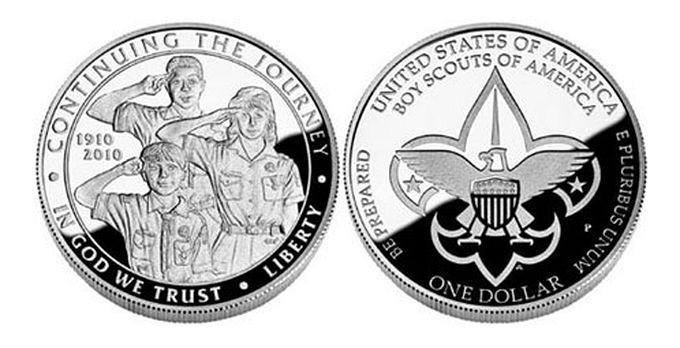
United States Mint. Obverse: designer Donna Weaver (Artistic Infusion Program), sculptor Charles L. Vickers. Reverse: sculptor-engraver Jim Licaretz · public domain · source

When the U.S. Mint put this dollar on sale in March 2010, demand was so fierce it jammed the website and the phone lines. Buyers cleared more than half the legal maximum in under a week — for a coin honoring a youth organization turning a hundred years old.

The story behind the coin

On February 8, 1910, a publisher named W.D. Boyce filed papers in Washington to incorporate the Boy Scouts of America. A hundred years later, Congress decided that birthday deserved a coin.

The authority came from the Boy Scouts of America Centennial Commemorative Coin Act — Public Law 110-363 — signed by President George W. Bush on October 8, 2008. It told the Mint to strike a silver dollar for the centennial. Congress had grown fond of these one-year commemoratives: limited runs that mark an anniversary, raise money for a cause, and then stop. This one capped the run at 350,000 coins, no more.

What nobody fully expected was the stampede. The coins went on sale March 23, 2010. Within four days the Mint had sold roughly 200,000 — well over half the entire authorized mintage. Demand overwhelmed the Mint's online store and call center. By the end of the first week, buyers had taken 214,673 coins. Both finishes sold out before summer.

The design

The obverse — the heads side — does something most coins don't: it puts children front and center. A Cub Scout stands in the foreground; behind him, a Boy Scout and a female Venturer salute. The motto across the top reads "CONTINUING THE JOURNEY," with the dates 1910 and 2010 flanking the scene, alongside the usual "LIBERTY" and "IN GOD WE TRUST."

That obverse was designed by Donna Weaver of the Mint's Artistic Infusion Program — a roster of outside artists the Mint brought in to widen its visual range — and sculpted by Mint engraver Charles L. Vickers.

The reverse — the tails side — is cleaner: the universal emblem of the Boy Scouts of America, the fleur-de-lis-and-eagle device every Scout knows from their uniform. Around it run "BOY SCOUTS OF AMERICA," the Scout motto "BE PREPARED," "E PLURIBUS UNUM," and the denomination, "ONE DOLLAR." Mint sculptor-engraver Jim Licaretz did the reverse.

Note the absence of a religious or political argument on the metal itself. The coin simply shows the organization as it wanted to be seen in 2010: a living institution handing the journey down a generation.

Key facts

Year struck
2010
Denomination
One dollar (silver commemorative)
Mint / mint mark
Philadelphia (P)
Composition
90% silver, 10% copper
Weight
26.73 g
Diameter
38.1 mm
Edge
Reeded
Obverse designer
Donna Weaver (sculpted by Charles L. Vickers)
Reverse designer
Jim Licaretz
Authorizing act
Public Law 110-363, signed October 8, 2008
Mintage limit
350,000 (all finishes combined)
Final mintage
Proof 244,963; Uncirculated 105,020
Surcharge
$10 per coin to the National Boy Scouts of America Foundation

Collecting it

This is not a rare coin. With nearly 350,000 struck, almost anyone who wants one can find one. But it carries a few wrinkles worth knowing.

Both finishes are worth understanding. A "proof" is a specially made collector strike — polished dies and blanks produce a mirror field and frosted devices, the cameo look graders abbreviate DCAM. An "uncirculated" commemorative is struck for collectors too, but with an ordinary brilliant finish. The proof outsold the uncirculated by more than two to one (244,963 to 105,020), which makes the uncirculated the scarcer of the two — a quiet fact many buyers overlook.

Because these were sold straight to collectors in protective packaging, finding one in a top grade is not the challenge it is for a circulated coin. Value clusters instead around perfect-grade examples — a PCGS or NGC label reading MS70 or PR70, meaning flawless under magnification — and around early-release designations. The melt value of the silver also sets a floor: each coin holds roughly three-quarters of a troy ounce of pure silver.

One thing the coin always carries is its purpose. Of every sale price, $10 was a surcharge routed to the National Boy Scouts of America Foundation, earmarked for grants that extend Scouting into hard-to-serve communities. With the full run sold, that came to roughly $3.5 million for the cause.

Questions collectors ask

Why did the 2010 Boy Scouts silver dollar sell out so fast?

Demand from Scouting families, alumni, and collectors hit all at once when sales opened on March 23, 2010. Roughly 200,000 coins sold in the first four days — over half the 350,000 legal maximum — and the surge overwhelmed the Mint's website and phone systems. Both finishes were sold out by summer.

Who designed the Boy Scouts Centennial silver dollar?

Donna Weaver, of the Mint's Artistic Infusion Program, designed the obverse showing a Cub Scout with a Boy Scout and a Venturer; Mint engraver Charles L. Vickers sculpted it. Mint sculptor-engraver Jim Licaretz created the reverse, which features the BSA universal emblem.

Is the 2010 Boy Scouts dollar made of real silver?

Yes. It is struck in 90% silver and 10% copper, weighs 26.73 grams, and contains about three-quarters of a troy ounce of pure silver. That silver content sets a baseline value beneath the collector market.

What does 'CONTINUING THE JOURNEY' mean on the coin?

It is the motto inscribed on the obverse, flanked by the dates 1910 and 2010. It frames the centennial as a handoff between generations of Scouts rather than just a hundredth birthday.

How much of the price went to the Boy Scouts?

A $10 surcharge on every coin went to the National Boy Scouts of America Foundation, for grants extending Scouting into hard-to-serve areas. With the run sold out, that totaled about $3.5 million.

Sources