US coin · series

The 1997 Botanic Garden Silver Dollar

A coin for America's oldest garden — and a hidden nickel worth more than the dollar it came with.

The 1997 Botanic Garden Silver Dollar
United States Mint (source: usmint.gov) · public domain · source

In 1997 the U.S. Mint struck a silver dollar to honor the United States Botanic Garden. The dollar is a handsome, affordable commemorative. But the collectors who scrambled for it were really after a five-cent piece tucked into one special set — an ordinary-looking Jefferson nickel that the Mint had quietly given a brand-new finish.

The story behind the coin

In 1820, three of the men who built the country — George Washington had championed the idea, and Thomas Jefferson and James Madison carried it forward — saw a living museum of plants take root on the National Mall. President James Monroe signed the legislation that created it. The United States Botanic Garden has grown there ever since, making it one of the oldest continuously operating botanic gardens in the nation.

By the mid-1990s, that history had a round number attached to it: 175 years. The anniversary itself fell in 1995. Congress had already cleared the way for a coin to mark it, passing Public Law 103-328, which President Clinton signed on September 29, 1994. The Mint released the finished dollar on February 21, 1997 — a little late to the party, which is why the coin's design carries the dates 1820–1995 rather than 1997.

This is a commemorative — a coin struck to honor an event or anniversary, sold to collectors at a premium rather than spent at face value. Every Botanic Garden dollar carried a $10 surcharge on top of its price, money routed to the National Fund for the United States Botanic Garden to help pay for the new National Garden in Washington. Buy the coin, water the garden.

The design

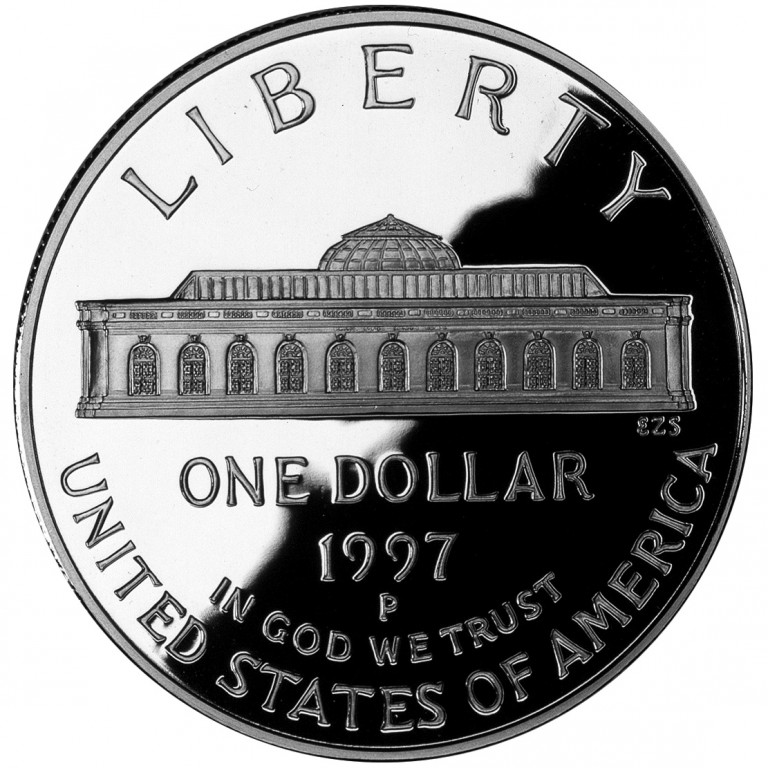
The obverse — the heads side — shows the graceful, multi-arched glass front of the Botanic Garden's Conservatory, the iron-and-glass greenhouse that anchors the institution on the Mall. It was modeled by Mint sculptor-engraver Edgar Z. Steever.

Turn the coin over and the architecture gives way to something softer: a single full rose at the center, ringed by a garland of roses and leaves curling around the rim. That reverse — the tails side — is the work of William C. Cousins, another longtime Mint engraver. The rose is a fitting emblem for a garden, and a quiet one; there's no grand allegory here, just a flower rendered in fine relief.

The dollar is struck in the classic American silver standard: 90% silver, 26.73 grams, 38.1 millimeters across — the same heft and metal as a vintage Morgan or Peace dollar. All of them came from the Philadelphia Mint and wear its P mint mark, the small letter that tells you which Mint building struck the coin.

Key facts

Year struck
1997 (Philadelphia, P mint mark)
Commemorates
175th anniversary of the U.S. Botanic Garden (dated 1820–1995)
Obverse designer
Edgar Z. Steever — the Conservatory building
Reverse designer
William C. Cousins — a rose and garland
Composition
90% silver, 10% copper · 26.73 g · 38.1 mm
Authorizing act
Public Law 103-328 (signed Sept. 29, 1994)
Surcharge
$10 per coin → National Fund for the U.S. Botanic Garden
Max authorized mintage
500,000 (combined)
Uncirculated mintage
58,505
Proof mintage
189,671
Original issue price
$30–$33 uncirculated · $33–$37 proof

Collecting it

On its own, the Botanic Garden dollar is one of the more attainable modern commemoratives. Congress authorized up to 500,000, but collectors took far fewer — 58,505 uncirculated and 189,671 proof — so neither version is rare, and both still trade close to the value of their silver. A pleasant coin, not a trophy.

The trophy is hiding elsewhere. The Mint packaged some of the dollars into a Coinage and Currency Set: the silver dollar, a $1 Federal Reserve Note, and a 1997-P Jefferson nickel. The catch was the nickel. For this set the Mint gave it a special matte (satin) finish — a soft, sandblasted-looking surface struck on specially prepared dies and planchets, unlike any nickel you'd pull from your change.

Only 25,000 of those sets were sold. That single number turned a five-cent coin into a key date. Because the matte 1997-P nickel exists nowhere else, anyone building a complete Jefferson nickel set has to find one — and there are only 25,000 to go around, fewer than survive in top grade. The result is the kind of inversion collectors love: a nickel that routinely outsells the silver dollar it shipped beside. (One documented auction record shows a graded 1997-P matte nickel bringing $104.50 in 2018; prices move with the market, so treat any single figure as a snapshot, not a quote.)

So when you weigh this issue, ask which coin you're really after. The dollar is a solid, low-cost commemorative. The set is a hunt for a tiny, deliberately scarce nickel — and a reminder that mintage, not metal, is what makes a modern coin chase-worthy.

Questions collectors ask

Why is the 1997 matte Jefferson nickel so collectible?

The U.S. Mint gave it a special matte (satin) finish and sold it only inside the 1997 Botanic Garden Coinage and Currency Set — just 25,000 sets were made. Because it exists nowhere else, anyone completing a Jefferson nickel collection has to track one down, which keeps demand high and supply fixed.

What anniversary does the Botanic Garden dollar commemorate?

The 175th anniversary of the United States Botanic Garden, which was established in Washington in 1820. The milestone fell in 1995 — that's why the coin is dated 1820–1995 even though it was struck in 1997.

Who designed the coin?

Mint engraver Edgar Z. Steever designed the obverse, showing the Botanic Garden's arched glass Conservatory. William C. Cousins designed the reverse, a single rose framed by a garland of roses.

How rare is the silver dollar itself?

Not very. Up to 500,000 were authorized, but only 58,505 uncirculated and 189,671 proof coins were sold. Both versions are common and trade close to their silver value — the scarcity in this issue lives in the matte nickel, not the dollar.

Where was it struck, and what is it made of?

All Botanic Garden dollars were struck at the Philadelphia Mint and carry a P mint mark. Each is 90% silver, weighs 26.73 grams, and measures 38.1 mm — the traditional U.S. silver-dollar standard.

Sources