US coin · series

The 1993 Bill of Rights Silver Dollar

A coin for the first ten amendments — that never once pictures them.

The 1993 Bill of Rights Silver Dollar
U.S. Mint (www.usmint.gov) · public domain · source

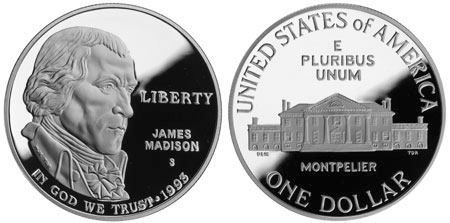
In 1993 the U.S. Mint struck a silver dollar to celebrate the Bill of Rights. Look at it closely and you'll find a portrait of James Madison on one side and his Virginia country house on the other — and not a single word or image of the amendments it was minted to honor.

The story behind the coin

By the early 1990s, Congress had a habit. When a national anniversary came around, it authorized a commemorative coin — a special-issue piece sold above face value, with the markup steered toward a worthy cause. The 200th birthday of the Bill of Rights was exactly that kind of occasion.

The first ten amendments to the Constitution were ratified in December 1791. They are the guarantees Americans quote without thinking — free speech, a fair trial, the right against unreasonable search. And the man most responsible for shepherding them through the new Congress was James Madison, the Virginian who drafted them and pushed a skeptical House to adopt them.

So Congress passed the James Madison–Bill of Rights Commemorative Coin Act (Public Law 102-281) and ordered up a three-coin program for 1993: a clad half dollar, this silver dollar, and a small $5 gold piece. Every coin carried a surcharge — extra dollars baked into the price — earmarked for the James Madison Memorial Fellowship Trust Fund, which pays for graduate teachers to study the Constitution. The coins went on sale January 22, 1993. Buying one was, in effect, a donation to civics education with a silver dollar attached.

What the coin shows

Here is the quiet oddity at the center of this coin. It was minted for the Bill of Rights — and the Bill of Rights is nowhere on it.

The obverse — the heads side — carries a portrait of James Madison, designed by William Krawczewicz. The reverse — the tails side — shows Montpelier, Madison's plantation home in the Virginia Piedmont, designed by Dean McMullen. A handsome man and a handsome house. Both honor Madison. Neither depicts the amendments, the document, or the act of writing them.

That's not an accident of one coin. The program split the storytelling across three pieces. The half dollar shows Madison actually penning the Bill of Rights; the $5 gold coin shows him reading it. The silver dollar was handed the man and the home. Collectors have noticed for thirty years that the dollar — the centerpiece denomination — is the one that says the least about the thing it commemorates.

A note on the credits, because catalogs differ: the designs are by Krawczewicz (obverse) and McMullen (reverse), with the working models sculpted at the Mint by engraver Thomas D. Rogers. A designer draws the concept; a sculptor-engraver translates it into the three-dimensional relief — the raised and lowered surfaces — that a die can actually strike into metal.

Key facts

Subject
Bicentennial of the Bill of Rights (1791–1991), honoring James Madison
Year struck
1993
Authorizing act
James Madison–Bill of Rights Commemorative Coin Act (Public Law 102-281)
Obverse design
Portrait of James Madison — William Krawczewicz
Reverse design
Montpelier, Madison's home — Dean McMullen
Composition
90% silver, 10% copper
Weight / diameter
26.73 g · 38.1 mm · reeded edge
Uncirculated
1993-D (Denver) — 98,383 struck
Proof
1993-S (San Francisco) — 534,001 struck
Maximum authorized
900,000 (proof + uncirculated combined)
Surcharge
$7 per dollar → James Madison Memorial Fellowship Trust Fund

Collecting it

This is a one-year, two-mint coin, which keeps the chase simple. There is the 1993-D in uncirculated finish from Denver, and the 1993-S in proof finish — mirror-bright fields, struck twice from polished dies — from San Francisco. Most collectors who want the type just want one of each.

The numbers tell the real collecting story. The Mint was authorized to make up to 900,000 silver dollars and sold a fraction of that. The proof did the heavier lifting at 534,001 coins; the uncirculated 1993-D came in at just 98,383 — a genuinely modest figure for a modern commemorative. That low business-strike mintage is the reason the uncirculated piece, not the flashier proof, is usually the harder of the two to find.

Because these were sold straight from the Mint in protective packaging, survivors tend to grade high. The premiums that collectors chase therefore cluster at the very top of the scale — the difference between an ordinary high grade and a near-flawless one — rather than across a long ladder of dates and mint marks. The whole 1993 program, half dollar through gold, is a popular "type set" target precisely because it's compact, affordable in silver, and tells a clean piece of constitutional history.

Questions collectors ask

Why doesn't the Bill of Rights silver dollar actually show the Bill of Rights?

The 1993 program spread its imagery across three coins. The half dollar shows Madison writing the document and the $5 gold coin shows him reading it, while the silver dollar was given a portrait of Madison and a view of his home, Montpelier. The dollar honors the man rather than the amendments — a quirk collectors still point out.

What's the difference between the 1993-D and 1993-S?

The 1993-D was struck at Denver in an uncirculated (business-strike) finish; the 1993-S was struck at San Francisco as a proof, with mirror fields and frosted devices from specially prepared dies. They are the same design in two finishes from two mints.

Which one is rarer?

By mintage, the uncirculated 1993-D is scarcer: 98,383 struck versus 534,001 of the 1993-S proof. The proof sold in far larger numbers, so the Denver uncirculated coin is the harder of the two to track down.

Is the coin made of real silver?

Yes. It is 90% silver and 10% copper — the classic U.S. coin-silver alloy — weighing 26.73 grams. That gives it a meaningful silver content quite apart from any collector premium.

Where did the extra money go?

Each silver dollar carried a $7 surcharge above its cost. Under the authorizing act, those surcharges funded the James Madison Memorial Fellowship Trust Fund, which supports graduate study and teaching of the U.S. Constitution.

Sources