US coin · series

The 1993 Bill of Rights $5 Gold — Madison's Coin

A West Point half eagle for the 200th birthday of America's first ten amendments.

The 1993 Bill of Rights $5 Gold — Madison's Coin
U.S. Mint (www.usmint.gov), U.S. Department of the Treasury · public domain · source

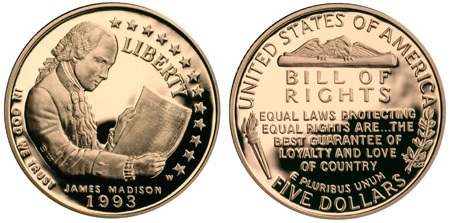
In 1993 the United States put James Madison on a tiny gold coin and showed him doing the one thing history remembers him for: reading the Bill of Rights. Two hundred years earlier he had pushed those ten amendments through a skeptical Congress. This coin is the country's quiet thank-you.

The story behind the coin

James Madison did not want a Bill of Rights. He thought the Constitution was enough, and that listing specific freedoms might imply the government could touch everything left off the list. Then he listened to the states, changed his mind, and became the man who shepherded the first ten amendments through the First Congress in 1789. They were ratified in December 1791.

Two centuries later, Congress decided that deserved a coin. The James Madison–Bill of Rights Commemorative Coin Act (Public Law 102–281) authorized a three-coin set for the bicentennial: a clad half dollar, a silver dollar, and this little gold piece — a half eagle, the old name for the United States $5 gold coin. All three went on sale together on January 22, 1993.

The money raised had a purpose. Every coin carried a surcharge — a built-in donation baked into the price — and those surcharges flowed to the James Madison Memorial Fellowship Trust Fund, which pays for graduate study of the Constitution by teachers. So buying the coin funded the teaching of the very document it celebrates. That tidy loop was the whole point.

The design

Most coins show a portrait. This one shows a scene. On the obverse — the heads side — Madison stands in profile, reading a copy of the Bill of Rights he holds in his hands. Thirteen stars run down the right edge, one for each original state. It was designed by Scott R. Blazek. Showing the man studying his own handiwork, rather than just posing, is what gives the coin its character.

The reverse — the tails side — was designed by Joseph D. Pena. It builds its picture around Madison's own words, framed by an eagle, the torch of freedom, and a laurel branch. The quotation reads: "Equal laws protecting equal rights are the best guarantee of loyalty and love of country." It is a real Madison line, and a pointed one for a coin about the rights of citizens.

The coin is small — just 21.6 millimeters across, smaller than a U.S. nickel — and struck in 90% gold, the same classic alloy used for circulating American gold a century before. It carries the W mint mark of the West Point Mint in New York, where the nation's gold coinage is struck.

Key facts

Denomination
$5 (gold half eagle)
Year struck
1993
Honors
Bicentennial of the Bill of Rights; James Madison
Authorizing act
James Madison–Bill of Rights Commemorative Coin Act (Pub. L. 102–281)
Obverse designer
Scott R. Blazek
Reverse designer
Joseph D. Pena
Mint
West Point (W mint mark)
Composition
90% gold (0.2419 oz gold), balance silver + copper
Weight
8.359 g
Diameter
21.6 mm
Edge
Reeded
Uncirculated mintage
23,266
Proof mintage
78,651
Surcharge went to
James Madison Memorial Fellowship Trust Fund

Collecting it

There are only two coins to chase here, both from 1993 and both from West Point: the uncirculated version (a regular finish) and the proof (a mirror-field, frosted-device finish made for collectors, struck with polished dies). The proof is far more common, with 78,651 struck against just 23,266 uncirculated pieces — so for once it is the business-strike coin, not the proof, that is the harder find.

Neither number is large. For comparison, a circulating coin runs into the hundreds of millions. The whole point of a modern commemorative is scarcity by design: it is sold for a limited window, then never struck again. The Bill of Rights program, like many U.S. commemoratives of the early 1990s, sold below its authorized ceiling — collectors had a lot of new programs to choose from those years — which is exactly why the surviving mintages stayed modest.

Because every example contains close to a quarter-ounce of gold, the coin always carries a metal floor underneath its collector value. What lifts a particular coin above that floor is condition. In slabbed grades — coins sealed and graded by services like PCGS and NGC — the top-grade proofs and the scarcer high-grade uncirculated pieces are where collectors compete. A flawless coin from a 30-year-old program is rarer than its mintage suggests, because most were handled, toned, or lightly marked along the way.

Questions collectors ask

What does the 1993 Bill of Rights $5 gold coin commemorate?

It marks the 200th anniversary of the Bill of Rights — the first ten amendments to the U.S. Constitution, ratified in 1791 — and honors James Madison, who guided those amendments through the First Congress.

How many were made?

The West Point Mint struck 23,266 uncirculated coins and 78,651 proof coins in 1993. The uncirculated version is the scarcer of the two.

Who designed it?

Scott R. Blazek designed the obverse, which shows Madison studying the Bill of Rights. Joseph D. Pena designed the reverse, built around a Madison quotation with an eagle, a torch, and a laurel branch.

How much gold is in it?

It's a $5 gold half eagle struck in 90% gold, containing about 0.2419 troy ounce of gold. It weighs 8.359 grams and measures 21.6 mm across.

Was it part of a set?

Yes. The Bill of Rights program also included a clad half dollar and a silver dollar, both also released January 22, 1993. The three were sold individually and in sets.

What does the W mint mark mean?

W is the mint mark of the West Point Mint in New York, where U.S. gold coinage is struck. Every coin in this issue carries it.

Sources