US coin · series

The 2006 Benjamin Franklin 'Founding Father' Silver Dollar

A dollar that carries a picture of the first dollar America ever designed.

The 2006 Benjamin Franklin 'Founding Father' Silver Dollar
U.S. Mint (www.usmint.gov) · public domain · source

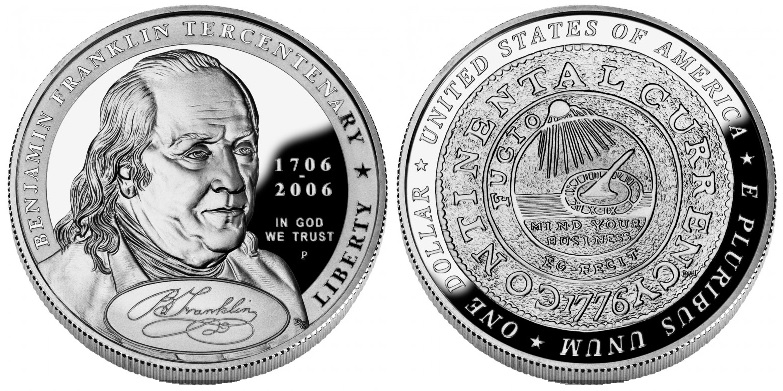
For Franklin's 300th birthday, the U.S. Mint did something clever: it put a coin on a coin. The reverse of this 2006 silver dollar reproduces the 1776 Continental dollar — the very first pattern dollar the new nation tried to strike, designed, the story goes, by Franklin himself. Right down to its odd, blunt motto: "Mind Your Business."

The story behind the coin

Benjamin Franklin was born on January 17, 1706. Three hundred years later, Congress decided that anniversary deserved a coin.

The Benjamin Franklin Commemorative Coin Act (Public Law 108–464) became law on December 21, 2004. It told the Mint to strike silver dollars for one year only — 2006 — and it did something unusual: it ordered two different designs of the same man. One would show Franklin the young scientist, kite and all. The other would show Franklin the statesman, the Founding Father. This page is about that second coin.

Why two coins? Because Franklin refused to be one thing. Printer, postmaster, inventor, diplomat, signer of the Declaration of Independence and the Constitution — no single image holds him. So the law split him in half and let collectors pick which Franklin to own. Most chose to chase both.

Each coin carried a $10 surcharge — money added on top of the price — and by law all of it went to the Franklin Institute in Philadelphia, the science museum that carries his name, to fund the official Franklin Tercentenary celebration. A tercentenary is simply a 300th anniversary.

The design

The obverse — the heads side — was designed by U.S. Mint sculptor-engraver Don Everhart. It shows Franklin in his maturity, three-quarters to the right, the face the world knew from the peace table in Paris. Below the bust sits something most coins never carry: Franklin's actual signature, set in a small oval. Around it run the words BENJAMIN FRANKLIN TERCENTENARY and the dates 1706–2006.

Then turn it over, and the design does something rare. The reverse, by Mint sculptor-engraver Donna Weaver, is not a fresh allegory — it is a faithful picture of another coin. Specifically, the 1776 Continental dollar: the first pattern dollar struck for the would-be United States. (A pattern is a trial coin, made to test a design, not for everyday spending.)

That older coin is itself attributed to Franklin — the design is widely credited to him, though scholars still debate the exact attribution. Its center is a sundial under a blazing sun, with two words that have puzzled people for 250 years: FUGIO and MIND YOUR BUSINESS. Fugio is Latin for "I fly." Read together with the sundial, it's a pun on time: time flies — so mind your business, get on with your work. The surrounding inscription, CONTINENTAL CURRENCY, and the curt EG FECIT ("E.G. made it," for an engraver still unidentified with certainty) come straight off the 1776 original.

So this is a coin of a coin — a 2006 silver dollar that holds up, like a mirror, the first dollar the country ever tried to make. The man on the front designed the coin on the back.

Key facts

Denomination
Silver dollar ($1)
Year struck
2006 (one year only)
Mint
Philadelphia (P mint mark)
Obverse designer
Don Everhart
Reverse designer
Donna Weaver
Composition
90% silver, 10% copper
Weight
26.73 g (≈0.7736 oz pure silver)
Diameter
38.1 mm (1.5 in)
Edge
Reeded
Authorizing act
Benjamin Franklin Commemorative Coin Act, Public Law 108–464 (Dec 21, 2004)
Surcharge
$10 per coin to the Franklin Institute (Tercentenary Commission)
Mintage limit
250,000 (Founding Father design)
Proof mintage
142,000 (2006-P)
Uncirculated mintage
58,000 (2006-P)

Collecting it

This is a modern commemorative, so there are no great rarities to hunt — but there is a clean, finite story. The law capped the Founding Father design at 250,000 coins, and the Mint never came close. The final tallies are modest: about 142,000 proofs and roughly 58,000 uncirculated pieces, both from Philadelphia. The uncirculated version is the scarcer of the two.

A proof is a specially made collector coin — polished dies, careful strikes, a mirror field behind a frosted design. The uncirculated version (often called "Burnished" for these modern issues) has a softer satin finish. Both came packaged from the Mint, so most survive in high grade. Because the supply is small and was never replenished, the whole series sits close to its silver value with a collector premium on top.

For a collector, the natural move is the pair: this Founding Father dollar beside its sibling, the 2006 Franklin "Scientist" dollar. Two coins, two halves of one extraordinary man, struck in the same year for the same 300th birthday. Owned together, they tell the story the way Congress intended.

Questions collectors ask

What's the difference between the Franklin 'Founding Father' and 'Scientist' dollars?

They're two separate 2006 silver dollars from the same act. The Founding Father coin shows a mature Franklin with his signature, and a reverse reproducing the 1776 Continental dollar he designed. The Scientist coin shows a younger Franklin tied to his electrical experiments. Different designs, same year, same purpose — Franklin's 300th birthday.

Why does the back say 'Mind Your Business'?

The reverse copies the 1776 Continental dollar, whose central design is a sundial with the Latin word FUGIO ('I fly') and the phrase MIND YOUR BUSINESS. Together they read as a pun: time flies, so get to work. The 2006 coin reproduces that original motif faithfully.

Is the 2006 Franklin dollar rare?

No — it's a modern commemorative with a known, modest mintage: about 142,000 proofs and 58,000 uncirculated of the Founding Father design, all from Philadelphia. The uncirculated version is the harder of the two to find.

Who designed it, and where was it struck?

Don Everhart designed the obverse and Donna Weaver the reverse, both U.S. Mint sculptor-engravers. Every coin was struck at the Philadelphia Mint and carries a P mint mark.

Did Benjamin Franklin really design a coin?

The 1776 Continental dollar shown on the reverse is widely attributed to Franklin, and its 'Fugio / Mind Your Business' design later reappeared on the 1787 Fugio cent. Scholars still debate the precise attribution, but the link to Franklin's thinking is strong and long-standing.

Sources