US coin · series

The Battle of Gettysburg Half Dollar

A coin that set a Union veteran and a Confederate veteran side by side — and meant it.

The Battle of Gettysburg Half Dollar
Public domain · source

Seventy-five years after the bloodiest three days on American soil, the Mint struck a half dollar that put the two sides of that war on the same face, looking the same direction. Most of them never sold.

The story behind the coin

In July 1938, a few thousand very old men gathered on the fields at Gettysburg. They were the last veterans of the battle — the youngest pushing ninety — and they had come from North and South to shake hands across the stone walls they had once fought over. President Franklin Roosevelt lit the Eternal Light Peace Memorial that week. It still burns today.

This half dollar was made for that reunion. Congress authorized it on June 16, 1936, to honor the 75th anniversary of the battle, which was fought July 1–3, 1863. Do the arithmetic and the anniversary lands in 1938 — and that is exactly why the dates on this coin look so strange.

The law allowed up to 50,000 pieces, all from one mint and one design. The job of selling them fell to the Pennsylvania State Commission, the body running the anniversary commemoration. It was the kind of arrangement Congress used for most coins of the era: the government struck them, a sponsoring group bought them at face value, and the sponsor resold them to the public at a markup to raise money. The premium — the surcharge — was the whole point.

The selling did not go well. That story is below.

The design

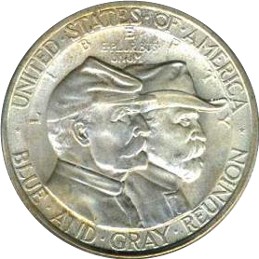
The Pittsburgh sculptor Frank Vittor designed both sides. The obverse — the "heads" side — shows two veterans in profile, their busts overlapping, both facing right: one in a Union cap, one in a Confederate hat, under the words BLUE AND GRAY REUNION. It is a quietly radical image. A generation after the war, here were the two enemies sharing a single coin, pointed the same way, all but indistinguishable.

That likeness was noticed at the time. The sculptor Paul Manship reportedly remarked that the two soldiers looked like near-twins — and observers have wondered ever since whether Vittor meant it as a comment on a war of brother against brother. Treat that as a good story rather than documented intent; what's certain is that the two faces are deliberately, strikingly alike.

The reverse — the "tails" side — carries the shields of the Union and the Confederacy, divided by a fasces: a bound bundle of rods around a double-bladed axe, an old Roman emblem of strength through unity. Sprays of oak and laurel flank the shields. The lettering frames the anniversary plainly: 1863, 75TH ANNIVERSARY, 1938, around BATTLE OF GETTYSBURG. The coin's own date, 1936, sits below — the year of the law, not the year of the strike.

So the dates tell three different stories at once: 1936 stamped on the coin, struck in 1937, sold for an anniversary in 1938, honoring a battle of 1863. Few coins wear their bureaucratic history so openly.

Key facts

Years
Dated 1936 (struck 1937)
Denomination
Half dollar (50 cents)
Designer
Frank Vittor (obverse and reverse)
Mint
Philadelphia (no mint mark)
Composition
90% silver, 10% copper
Weight / diameter
12.5 g / ~30.6 mm, reeded edge
Silver content
~0.3617 troy oz
Authorized maximum
50,000 (Act of June 16, 1936)
Net distributed
~26,928 — 23,100 unsold returned and melted
Original price
$1.65, later raised to $2.65
Honored
75th anniversary, Battle of Gettysburg (July 1–3, 1863)

Collecting it

There is one date, one mint, one design — so collecting this coin is not about chasing varieties. It is about condition and survival.

The sales failure is the heart of it. The Pennsylvania State Commission offered the coins at $1.65 each through late 1937 and into the 1938 reunion. They moved slowly. When the American Legion's Pennsylvania department took over the remaining stock, it tried raising the price to $2.65 — on the theory that a dearer coin looks rarer and more desirable. It didn't work. In the end, 23,100 unsold pieces went back to the Philadelphia Mint to be melted, leaving a net of roughly 26,928 in collectors' hands.

That melting is why the coin is genuinely scarce today — far scarcer than the 50,000 ceiling suggests. The melted survivors were the ones nobody wanted in 1938; the ones that lived were largely tucked away by collectors, which is also why a fair number survive in high, lustrous grades. The premium climbs sharply at the top of the grading scale, where "mint state" — a coin that never circulated — shades from common to exceptional. A coin's grade, the number assigned for how well it survived, does most of the work in setting value here.

A practical note for buyers: because this is a well-known, high-value commemorative, it is one of the more counterfeited classic issues. Coins certified by a major grading service — sealed in a tamper-evident holder, or "slab" — trade at a clear premium for exactly that reason.

Questions collectors ask

Why is the coin dated 1936 if it honors a 1938 anniversary?

The date follows the authorizing law, not the strike or the event. Congress passed the act on June 16, 1936, so the coins were dated 1936 — even though they were actually struck in 1937 and sold for the 75th-anniversary reunion in 1938. The battle itself was fought in 1863; 1863 plus 75 years lands in 1938, and that span (1863–1938) is spelled out on the reverse.

Why are so many fewer than 50,000?

The law allowed up to 50,000, and just over 50,000 were struck (including a small number of assay pieces). But the coins sold poorly, even after the price was raised. Roughly 23,100 unsold pieces were sent back to the Philadelphia Mint and melted, leaving a net of about 26,928 distributed — which is why the coin is genuinely scarce today.

Who designed it?

Frank Vittor, a Pittsburgh sculptor born in Italy in 1888. He's better known for monumental public statues — including the 17-foot bronze of baseball's Honus Wagner now at PNC Park — and designed both sides of this half dollar.

Does it have a mint mark?

No. The law required a single mint, and all were struck at Philadelphia, which did not use a mint mark on this issue. Every genuine example is a Philadelphia coin.

What does the bundle-and-axe symbol on the back mean?

It's a fasces — a bound bundle of rods around a double-bladed axe, an ancient Roman emblem of strength through unity. Here it sits between the Union and Confederate shields, the design's plain statement of a reunited country.

Sources