US coin · series

The First Coin America Made That Wasn't Flat

In 2014, the U.S. Mint struck a silver dollar shaped like a baseball — and almost couldn't do it.

The First Coin America Made That Wasn't Flat
United States Mint · public domain · source

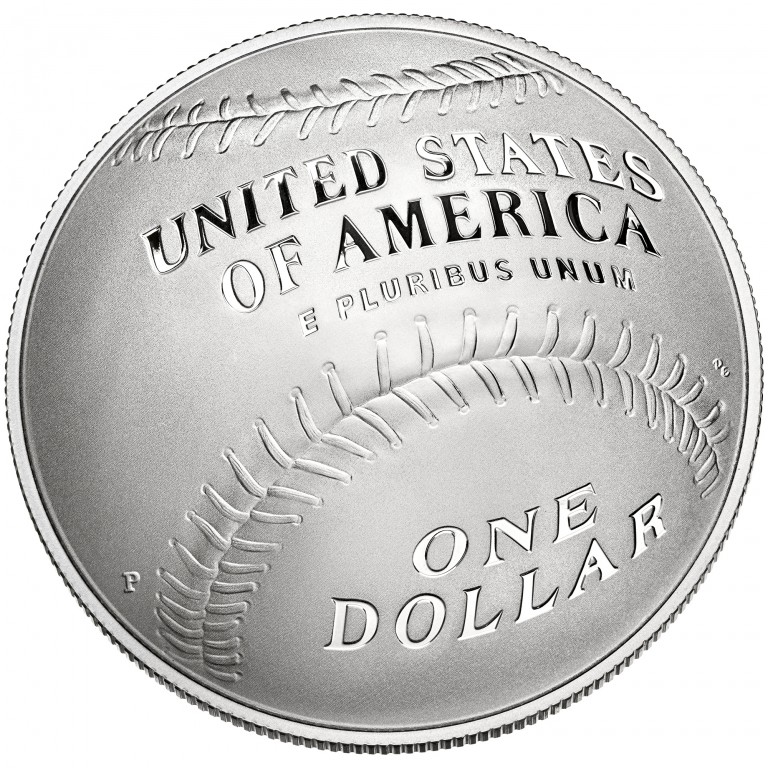
For more than two centuries, every coin the United States made was flat. Then in 2014 the Mint cupped one into a dome — concave on the front, bulging like a baseball on the back — and put a worn leather glove on the heads side. It was the first curved coin in American history, and it sold out in about two weeks.

The coin that bent the rules

For 222 years, the United States Mint made flat money. Coins were discs. That was simply what a coin was.

Then Congress asked for one that wasn't. The National Baseball Hall of Fame Commemorative Coin Act — signed into law on August 3, 2012 — told the Mint to honor the Hall's 75th anniversary with a three-coin set, and to make those coins curved: dished on the front, domed on the back, so the reverse would round up like a baseball in your palm. The law even pointed to a model: a 2009 coin the French Mint had curved for the International Year of Astronomy. Nobody in the United States had ever struck one.

That was the whole point. A flat baseball is a contradiction. A government that wanted to celebrate the national pastime in metal had to figure out how to make the metal itself behave like the game.

This page is about the middle coin of that set — the silver dollar. There was also a small $5 gold coin and a copper-nickel half dollar, all sharing the same two faces. The dollar is the one most collectors reach for: real silver, a generous size, and the same trick of physics that makes the whole program famous.

What it shows — and who dreamed it up

The obverse — the heads side — is a baseball glove. Not a generic mitt, but a specific, broken-in, lovingly-creased glove rendered in fine relief.

It came from a contest. In 2013 the Mint threw open the obverse design to the public and drew in thousands of entries. The winner was Cassie McFarland, a graphic artist from San Luis Obispo, California, with a design she called A Hand Full of Gold. She had modeled it on her own family's worn glove — and afterward donated that glove to the Hall of Fame, so the object that inspired the coin now sits in Cooperstown. Because the obverse is the concave side — the one that dishes inward — the glove looks like it's cradling a ball that isn't there. The shape does the storytelling.

The reverse — the tails side, the one that domes outward — is simply a baseball, stitches and all, by Mint sculptor-engraver Don Everhart. It carries the words a U.S. coin must carry: UNITED STATES OF AMERICA, E PLURIBUS UNUM, and ONE DOLLAR. Curved up into a hemisphere, it reads less like an engraving of a baseball and more like the thing itself.

That pairing — a cupped glove on one face, a domed ball on the other — is why people remember this coin. You don't need to know a word of numismatics to get the joke. You just have to hold it.

Key facts

Year
2014
Denomination
$1 (silver dollar)
Obverse designer
Cassie McFarland (public design competition)
Reverse designer
Don Everhart (U.S. Mint)
Composition
90% silver, 10% copper
Weight
26.73 g
Diameter
38.1 mm (1.500 in)
Shape
Curved — concave obverse, convex (domed) reverse
Mint mark
P (Philadelphia)
Authorizing act
National Baseball Hall of Fame Commemorative Coin Act (Pub. L. 112–152, Aug. 3, 2012)
Authorized mintage
400,000 silver dollars (across proof + uncirculated)
Reported sales
~268,000 proof + ~131,900 uncirculated — sold out
Surcharge
$10 per dollar to the National Baseball Hall of Fame
Released
March 27, 2014
Distinction
First curved coin ever struck by the U.S. Mint

Why it almost didn't happen

Curving a coin is harder than it sounds, and the dollar's dome is the deepest of the three — about 0.150 inch (3.81 mm) tall. To even practice, the Mint cut research dies on CNC milling machines just to simulate the dome's height and relief before committing to production tooling.

The real fight was die life. Early test runs on the curved half dollar wore the dies out at fewer than 100 coins per pair — useless for a coin meant to sell in the hundreds of thousands. The Mint reworked the geometry, in one case scaling a dome down to half its planned height, before the tooling would survive a real run. One surprise went the other way: the curved dies actually needed less force than flat ones — the silver dollar took roughly 185 tons per strike, about 30% under a comparable flat coin. (These production details come from the Mint via numismatic press; the engineering was a genuine learning curve, not a routine job.)

For collectors, three things make this coin matter. First, the firsts: it's the inaugural U.S. curved coin, a clean line in a 230-year history. Second, the cap: the law allowed only 400,000 silver dollars total, and the program sold out — opening-day demand alone reportedly swallowed close to 40% of the authorized run. Third, condition: because it's a modern proof and uncirculated issue, the chase isn't finding one — it's finding a flawless one, graded at the very top, where the curved field shows every contact mark. The coin is common; perfection in it is not.

Questions collectors ask

Why is the 2014 Baseball Hall of Fame dollar curved?

Congress wrote the curve into law. The National Baseball Hall of Fame Commemorative Coin Act (2012) required the coins to be domed so the reverse would resemble an actual baseball. The U.S. Mint had never struck a curved coin before — it modeled the technique on a 2009 curved coin from the French Mint.

Was this really the first curved U.S. coin?

Yes. Every U.S. coin before 2014 was flat. The Baseball Hall of Fame set — the $5 gold, this $1 silver dollar, and the half dollar — were the first curved coins the U.S. Mint ever produced, each with a concave (dished) front and a convex (domed) back.

Who designed it?

The glove on the obverse was designed by Cassie McFarland, a graphic artist who won a public design competition; she modeled it on her family's worn glove and later donated that glove to the Hall of Fame. The baseball on the reverse was sculpted by U.S. Mint engraver Don Everhart.

How many were made, and did it sell out?

The law authorized 400,000 silver dollars in total. The program sold out — reported sales were roughly 268,000 proofs and about 131,900 uncirculated coins. A $10 surcharge from each dollar went to the National Baseball Hall of Fame.

What is the coin made of?

90% silver and 10% copper, 26.73 grams, 38.1 mm across — a traditional silver-dollar alloy and size, just dished into a dome.

Sources