US coin · series

The $5 gold coin for a bird that came back from the brink

In 2008, the United States minted a gold commemorative to mark the bald eagle's recovery — the year its own national symbol stopped being endangered.

The $5 gold coin for a bird that came back from the brink
United States Mint · public domain · source

By the 1960s the bald eagle — the bird on the back of every American dollar — was nearly gone. In 2007 it was officially taken off the endangered list. The next year, the U.S. Mint struck a small gold coin to celebrate the comeback, with the surcharge funding eagle conservation.

The bird on the seal almost disappeared

The bald eagle has been the emblem of the United States since 1782. It sits on the Great Seal, on the back of currency, on the lectern the president speaks behind. And for a stretch of the 20th century, the real bird was vanishing.

The poison was DDT, a pesticide that washed into rivers, built up in fish, and then in the eagles that ate them. It thinned their eggshells until the eggs cracked under the weight of the nesting parent. By 1963 only about 417 nesting pairs were left in the lower 48 states. The country's living symbol was on its way out.

Then the law stepped in. DDT was banned in 1972. The Endangered Species Act of 1973 gave the eagle real protection. Slowly, the population climbed back. In 2007 the U.S. Fish and Wildlife Service removed the bald eagle from the list of threatened and endangered species — a rare, clean conservation win. Congress had already voted, back in 2004, to mark that moment in gold.

A coin Congress ordered before the eagle was even delisted

The authorizing law came first. The American Bald Eagle Recovery and National Emblem Commemorative Coin Act — Public Law 108-486 — was signed by President George W. Bush in December 2004, while the delisting was still working its way through the system. It told the Mint to strike three coins in 2008: a half dollar in copper-nickel clad, a silver dollar, and this $5 gold piece.

The timing was deliberate. The 2008 issue date lined up with the 35th anniversary of the Endangered Species Act of 1973 — the law that had given the eagle its shot. A commemorative coin in the U.S. system is struck for a single year and then never again; this one had a one-year window opening January 1, 2008.

Every coin carried a surcharge — money added on top of the metal-and-minting cost. For the $5 gold coin it was $35 per coin, and it didn't go to the Treasury. It went to the American Eagle Foundation in Tennessee, a nonprofit that cares for eagles and runs nesting and monitoring programs. Buying the coin paid, directly, for the bird it pictured.

What the coin shows

The obverse — the heads side — breaks from the usual portrait-of-a-statesman template. It shows two young bald eagles perched on a branch, one with wings spread, the other settled and tucked in, set in their natural habitat rather than against a flag or a seal. It is a quietly hopeful image: not the fierce adult of the war emblem, but the next generation, alive and nesting.

That obverse was designed by Susan Gamble, working through the Mint's Artistic Infusion Program — a roster of outside artists the Mint brought in to widen the look of American coinage — and sculpted into the die by Mint medallic sculptor Phebe Hemphill. (A die is the hardened steel stamp that strikes the image into the blank; the sculptor turns a drawing into the three-dimensional relief the die carries.)

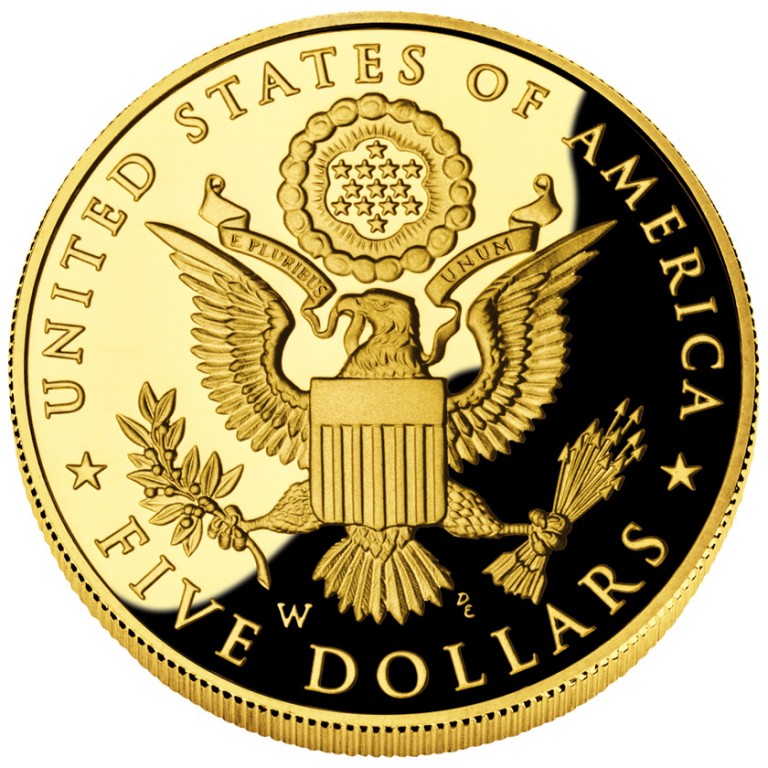
The reverse returns to tradition. It carries the Great Seal of the United States — the eagle with shield, olive branch, and arrows — taken from a 1903 engraving of the seal, sculpted by Don Everhart. So the coin holds both eagles at once: the living bird on the front, the heraldic symbol on the back.

Key facts

Year struck
2008 only
Denomination
$5 (gold commemorative)
Mint mark
W — West Point
Composition
90% gold, 10% alloy
Weight
8.359 g (0.2419 oz gold)
Diameter
21.6 mm
Obverse design
Two young eagles — Susan Gamble (design), Phebe Hemphill (sculpt)
Reverse design
Great Seal of the U.S. — Don Everhart
Authorizing act
Public Law 108-486 (2004)
Surcharge
$35 per coin → American Eagle Foundation
Reported sales — proof
≈59,269
Reported sales — uncirculated
≈15,009
Maximum authorized mintage
100,000 (all $5 options combined)

Collecting the 2008 $5 Bald Eagle

Every one of these coins came from a single mint — West Point — so they all wear the W mint mark. There is no rare branch-mint version to chase. The collecting interest sits instead in format and grade.

The Mint sold the coin two ways: as a proof (struck twice on polished dies for a mirror finish, with frosted devices) and as an uncirculated business strike. The proof sold far better — roughly 59,000 went out — while the uncirculated version is the scarcer of the pair, with reported sales of only about 15,000. That makes the uncirculated 2008-W the one collectors notice when they want the harder coin to find. Both numbers are well under the 100,000 the law allowed, so the program never came close to its ceiling.

Because these were sold straight from the Mint to collectors and rarely circulated, surviving coins tend to grade high. The premium ones are the top certified grades — MS70 for the uncirculated, PR70 Deep Cameo for the proof — where the strike is flawless under magnification. Below that, much of the coin's value tracks the gold itself: just under a quarter ounce of pure gold sits in every piece, so the bullion floor moves with the gold price.

Questions collectors ask

What is the 2008 $5 Bald Eagle coin worth?

It depends on format and grade. Each coin holds about 0.242 ounces of gold, which sets a floor that moves with the gold price. Top-graded examples — MS70 uncirculated or PR70 Deep Cameo proof — carry a collector premium above that floor, and the scarcer uncirculated strike (around 15,000 sold) generally commands more than the proof for a given grade.

Why does the 2008 Bald Eagle gold coin exist?

Congress ordered it in 2004 (Public Law 108-486) to mark the bald eagle's recovery and its removal from the endangered species list, and to coincide with the 35th anniversary of the Endangered Species Act of 1973. A $35 surcharge on each gold coin funded the American Eagle Foundation's conservation work.

Where was the 2008 $5 Bald Eagle minted?

All of them were struck at the West Point Mint, so every coin carries the W mint mark. There is no other mint variety.

Who designed the 2008 $5 Bald Eagle gold coin?

The obverse — two young eagles on a branch — was designed by Susan Gamble of the Mint's Artistic Infusion Program and sculpted by Phebe Hemphill. The reverse, the Great Seal of the United States, was sculpted by Don Everhart.

Is the 2008 $5 Bald Eagle pure gold?

No. Like classic U.S. gold coinage, it is 90% gold and 10% alloy for durability. The whole coin weighs 8.359 grams and contains about 0.242 ounces of actual gold.

Sources