US coin · series

The 1995 Olympic Baseball Half Dollar

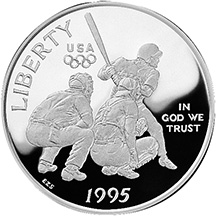
A swing, a catcher, an umpire mid-call — the only U.S. coin to put a live ballgame in your palm.

The 1995 Olympic Baseball Half Dollar
United States Mint · public domain · source

Most coins show a portrait or a building. This one shows a moment: the batter loaded, the catcher crouched, the umpire leaning in for the call. Struck for the 1996 Atlanta Olympics, it remains one of the most affordable little dramas in American coinage.

The story behind the coin

In 1992, Congress placed a very large bet on the 1996 Atlanta Olympics. Public Law 102-390, signed on October 6, 1992, authorized a sprawling commemorative coin program to help bankroll the Centennial Games — sixteen different designs spread across half dollars, silver dollars, and five-dollar gold coins, issued in two waves, 1995 and 1996.

The idea was simple and old: collectors pay a premium for a commemorative coin, and a slice of every sale — the surcharge — flows to the cause. Here the money went to the Atlanta Committee for the Olympic Games, through Atlanta Centennial Olympic Properties, with a share to the United States Olympic Committee. Buy the coin, fund the Games.

The Baseball half dollar belonged to the 1995 wave. It is a clad coin — copper-nickel bonded over a pure copper core, the same recipe as the dimes and quarters in your pocket, not silver. That kept the price low and put it at the entry point of the whole program: the coin a curious fan could afford without flinching.

The design

Most coins freeze a person. This one freezes a play. The obverse — the heads side — by U.S. Mint sculptor-engraver Edgar Z. Steever shows three figures at once: a batter at the top of his swing, a catcher braced behind the plate, and an umpire leaning in to make the call. It reads less like a portrait and more like a photograph stopped a half-second before the pitch arrives.

That choice was deliberate. Baseball is a game of held breath between motions, and Steever built the design around that pause. The legends are spare — LIBERTY, IN GOD WE TRUST, and the date 1995 — so nothing competes with the action.

The reverse — the tails side — by sculptor-engraver Thomas James (T. James) Ferrell carries the official logo of the Atlanta Committee for the Olympic Games set against a globe, with UNITED STATES OF AMERICA, the denomination HALF DOLLAR, and E PLURIBUS UNUM. It ties the ballgame on the front to the Olympic movement it was minted to fund.

Key facts

Year struck
1995 (dated 1995)
Mint / mint mark
San Francisco — S
Denomination
Half dollar (50 cents)
Composition
Copper-nickel clad copper (no silver)
Weight
11.34 g
Diameter
30.61 mm
Edge
Reeded
Obverse designer
Edgar Z. Steever — batter, catcher, umpire
Reverse designer
T. James Ferrell — ACOG logo over a globe
Uncirculated mintage
164,605
Proof mintage
118,087
Maximum authorized
2,000,000
Authorizing act
Public Law 102-390 (Oct. 6, 1992)
Surcharge beneficiary
Atlanta Committee for the Olympic Games; U.S. Olympic Committee

Collecting it

Here is the surprise: a coin this charming is one of the cheapest commemoratives you can buy. The reason is arithmetic. The Olympic program was enormous — by the time both years were done, a collector chasing every design in both proof and uncirculated finishes faced dozens of coins. Buyers were overwhelmed, and demand split too many ways.

So even though the Baseball half dollar's final mintages were modest by the program's own ambitions — 164,605 uncirculated and 118,087 proof, far below the two-million ceiling Congress had set — the coins have stayed inexpensive on the secondary market, often trading for a few dollars over face. They sold originally at pre-issue prices of $10.50 (uncirculated) and $11.50 (proof).

The collecting angle, then, is condition rather than rarity. Because clad surfaces mark easily, a proof — a specially polished, mirror-field coin struck for collectors — in pristine, untouched condition is the version that holds interest. The hunt is for the perfect strike, not the scarce date. For a newcomer, that makes this a forgiving first commemorative: a real piece of Olympic history, with a great image, for very little money.

Questions collectors ask

Is the 1995 Olympic Baseball half dollar silver?

No. It is a copper-nickel clad half dollar — the same layered metal as a modern quarter, with no silver content. The Atlanta program's silver was reserved for the dollar coins; the half dollars, including Baseball, are clad. That is why it was the program's most affordable entry.

Why is it worth so little despite a low mintage?

The 1995–96 Atlanta Olympic program was so large — sixteen designs across two years, in multiple finishes — that collector demand was spread thin. With supply outpacing demand for the half dollars, the Baseball issue has stayed inexpensive on the secondary market for decades, despite mintages well under the authorized ceiling.

Who designed the coin, and what does it show?

Edgar Z. Steever designed the obverse, capturing a live moment of play — batter, catcher, and umpire mid-pitch. T. James Ferrell designed the reverse, with the Atlanta Committee for the Olympic Games logo set over a globe.

Did this coin actually pay for the Olympics?

In part. A surcharge built into every sale was directed to the Atlanta Committee for the Olympic Games (via Atlanta Centennial Olympic Properties) and the U.S. Olympic Committee, the standard funding mechanism for U.S. commemorative coins.

Is there a circulated version?

No. Like all modern U.S. commemoratives, it was sold directly to collectors in uncirculated and proof finishes and never released into general circulation. Both versions carry the San Francisco 'S' mint mark.

Sources