US coin · series

The Apollo 11 Silver Dollar: a coin curved like a spacesuit visor

In 2019 the US Mint marked fifty years since the Moon landing with a coin you cannot lay flat.

The Apollo 11 Silver Dollar: a coin curved like a spacesuit visor
US Mint (source: usmint.gov, Apollo 11 50th Anniversary commemorative coin program) · public domain · source

Most coins are flat discs. This one is a shallow dome — concave on the front, bulging on the back — so that the reverse cradles a tiny, mirrored reflection of Buzz Aldrin's helmet visor, exactly as it looked on the Moon. It was the first US commemorative dollar ever struck in pure .999 silver, and its winning face came not from a Mint staff artist but from a Maine sculptor who had been entering coin contests, and losing, for twenty years.

The story behind the coin

On July 20, 1969, two men walked on the Moon while roughly 600 million people watched on Earth. Fifty years later, Congress wanted a coin worthy of that moment — and it asked for something the US Mint had never tried for a commemorative this ambitious.

The Apollo 11 50th Anniversary Commemorative Coin Act became law in late 2016 (Public Law 114-282). It ordered a four-coin program for 2019: a $5 gold piece, this silver dollar, a clad half dollar, and an enormous five-ounce silver dollar. And it specified the part that makes these coins famous — they had to be curved.

Curving a coin is hard. A normal coin is stamped flat between two dies. A domed coin has to be formed in stages, and the Mint had only pulled it off once before, for the wildly popular 2014 National Baseball Hall of Fame coins. Congress essentially said: do it again, for the Moon. The curve is not decoration. The concave front — the obverse, the "heads" side — dips inward like the inside of a helmet, and the convex back swells outward like the bubble of an astronaut's visor.

The design

The law split the design in two, and the split is the whole story of this coin.

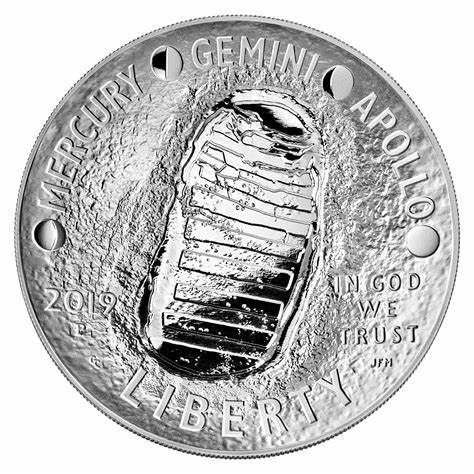
For the obverse, Congress demanded a public competition — open to any artist in the country. From May to June 2017 the Mint took submissions; 119 came in, and a jury drawn from the Commission of Fine Arts and the Citizens Coinage Advisory Committee narrowed them to 18 finalists. The winner was Gary Cooper, a sculptor from Belfast, Maine, who had entered Mint competitions before — including the 1998 Sacagawea dollar contest — and lost every time. His design is spare and patient: the words MERCURY, GEMINI, and APOLLO arranged around the rim, separated by the phases of the Moon, leading the eye to a single boot print pressed into lunar dust. "The footprint sums up the whole program for me," Cooper said. Mint sculptor Joseph Menna adapted it for striking.

The reverse was not up for debate. The act itself dictated it: a close-up of the helmet and visor of Buzz Aldrin, taken from one of the most reproduced photographs ever made — the shot Neil Armstrong took of Aldrin on the surface, in which Aldrin's gold visor mirrors back the photographer, the lunar module, and the desolate gray plain. Mint sculptor-engraver Phebe Hemphill rendered it. The convex curve of the coin does real work here: the reflective visor sits on a surface that genuinely bulges toward you, so the metal mimics the dome of the helmet it depicts. Aldrin, still living when the coins were struck, became one of the very few people to appear on a US coin during his own lifetime.

Key facts

Year struck
2019
Mint
Philadelphia (P)
Denomination
$1 (silver dollar)
Composition
.999 fine silver — the first US commemorative dollar struck in pure silver
Weight
26.73 g
Diameter
38.1 mm
Shape
Curved — concave obverse, convex reverse
Obverse designer
Gary Cooper (competition winner); engraved by Joseph Menna
Reverse designer
Phebe Hemphill (visor design mandated by Congress)
Authorizing act
Apollo 11 50th Anniversary Commemorative Coin Act, P.L. 114-282
Authorized maximum
400,000 silver dollars across all finishes
Surcharge
$10 per silver dollar — split among the Smithsonian, the Astronauts Memorial Foundation, and the Astronaut Scholarship Foundation

Collecting it

The Mint struck this dollar in two finishes — a proof (a mirror-field collector strike, made with polished dies and special blanks) and an uncirculated version with a softer, matte-like surface. Reported sales came to roughly 219,000 proofs and about 60,000 uncirculated pieces, comfortably under the 400,000 cap.

That matters for understanding the market. Many older US commemoratives are scarce because they sold poorly or were melted. The Apollo 11 dollar is the opposite: it sold well — the program moved over 600,000 coins across all denominations, the strongest US commemorative showing since the 2014 baseball coins. So no single date or mint mark is rare here; there is one year, one mint. What collectors chase instead is condition. On a curved, mirror-fielded coin, the smallest contact mark shows, which is why top third-party grades (a perfect Proof 70, for example) command a premium over the same coin a point or two lower. The uncirculated version, struck in smaller numbers, is the harder of the two finishes to find.

A note on the family: this dollar has two larger siblings worth knowing — the $5 gold curved coin and the showpiece five-ounce silver dollar, a three-inch curved disc that was a manufacturing feat in its own right and did sell out. They are separate coins, not varieties of this one.

Questions collectors ask

Why is the Apollo 11 silver dollar curved?

Congress required it. The curve makes the coin behave like an astronaut's helmet — the concave front dips inward, and the convex back bulges out so the reverse can carry a close-up of Buzz Aldrin's domed, reflective visor. The Mint had only used the dome-forming technique once before, on the 2014 Baseball Hall of Fame coins.

Who designed the Apollo 11 silver dollar?

The obverse — the footprint and the MERCURY/GEMINI/APOLLO inscriptions — was designed by Gary Cooper, a sculptor from Belfast, Maine, who won a public competition of 119 entries. Mint engraver Joseph Menna prepared it for striking. The reverse, showing Aldrin's visor, was created by Mint sculptor-engraver Phebe Hemphill from a design Congress mandated.

What does the reverse of the coin show?

A close-up of astronaut Buzz Aldrin's helmet and gold visor, taken from the famous July 20, 1969 photograph Neil Armstrong shot on the lunar surface. In the visor's mirror you can make out the reflection of Armstrong, the lunar module, and the surrounding plain.

Is the 2019 Apollo 11 silver dollar rare or valuable?

It isn't rare — there's only one year and one mint, and it sold well, with roughly 219,000 proofs and about 60,000 uncirculated coins. Value tracks the metal (one ounce of .999 silver) plus a premium for condition. The highest third-party grades and the scarcer uncirculated finish bring the most.

Why is .999 silver a big deal for this coin?

It was a first. Earlier US silver commemoratives were struck in 90% silver. The Apollo 11 dollars were the first US commemorative dollars made from .999 fine — essentially pure — silver, holding one troy ounce of precious metal.

Sources