US coin · series

The 1937 Antietam Half Dollar

Two enemy generals, one silver coin, and the deadliest day in American history.

The 1937 Antietam Half Dollar
United States Mint / William Marks Simpson · public domain · source

In 1937, the U.S. Mint put the faces of two men who had tried to destroy each other's armies on the same side of a coin. It honored a battlefield where 23,000 Americans fell in a single day — and almost nobody bought it.

The story behind the coin

On September 17, 1862, near a sleepy Maryland creek called the Antietam, more Americans were killed or wounded than on any other single day in the nation's history. By nightfall, roughly 23,000 men lay dead, dying, or maimed. The fighting was a tactical draw, but it stopped Robert E. Lee's first invasion of the North cold — and that was enough.

The aftermath changed the war. Days later, with a Union army no longer in retreat, Abraham Lincoln issued the preliminary Emancipation Proclamation. The battle that fed the bloodiest day in American history also opened the door to ending slavery.

Seventy-five years later, the people of Washington County, Maryland — where the fields are still scarred — wanted to mark the anniversary. So they did what dozens of American towns did in the 1930s: they asked Congress for a coin. On June 24, 1937, lawmakers authorized a commemorative half dollar, capped at 50,000 pieces, all of one design, all from one mint. The Washington County Historical Society would sell them and keep the proceeds — the standard deal for these coins, where a local group buys the issue from the Mint at face value and sells it at a markup to fund a cause.

The design

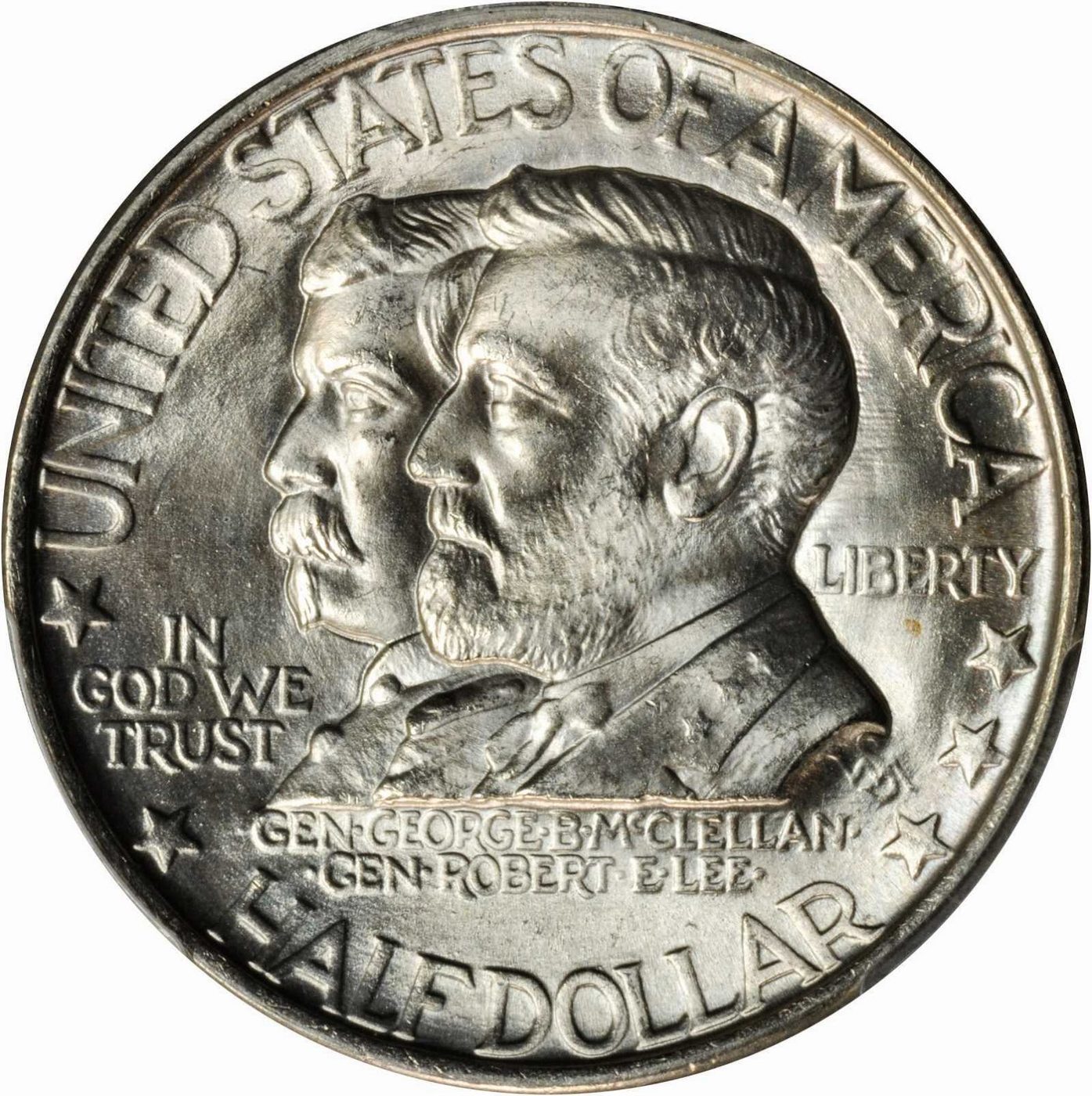
The coin's quiet boldness is on the obverse — the heads side. There, facing the same direction, are the two generals who commanded at Antietam: Confederate Robert E. Lee and Union George B. McClellan. Putting a Confederate commander on U.S. coinage was unusual; placing him shoulder to shoulder with his Union opponent, as equals, was a deliberate gesture of reconciliation — the kind of "brothers once more" sentiment that ran through American memory of the Civil War by the 1930s.

The reverse — the tails side — shows Burnside's Bridge, the three-arched stone span over Antietam Creek that Union troops fought for hours to cross. It became one of the battle's defining images. The inscription marks the seventy-fifth anniversary and the date of the battle, September 17, 1862.

Both sides came from Baltimore-based sculptor William Marks Simpson, who had already designed the Norfolk and Roanoke Island commemoratives. His relief — the raised depth of the design — is crisp and confident, and the Antietam is widely admired today as one of the better-struck, better-looking coins of the whole classic commemorative run.

Key facts

Year struck
1937
Denomination
Half dollar (50 cents)
Designer
William Marks Simpson
Mint
Philadelphia (no mint mark)
Authorized
Act of June 24, 1937 — capped at 50,000
Struck
50,000
Distributed / net mintage
18,028 (≈32,000 returned and melted)
Original issue price
$1.65 each
Composition
90% silver, 10% copper
Weight
12.5 g (≈0.3617 troy oz silver)
Diameter
30.6 mm
Edge
Reeded

Collecting it

Here is the twist that makes the Antietam a collector's coin. The Mint struck the full 50,000, but the public had soured on commemoratives. The mid-1930s saw a flood of these half dollars, plus a string of scandals — issues spun out into rare varieties, insiders flipping coins for profit. By 1937, buyers were exhausted. The Antietam sold poorly. Fewer than 18,028 found homes, and the roughly 32,000 unsold pieces went back to Philadelphia and into the melting pot.

That melting is the whole story of its value. A net mintage of 18,028 makes the Antietam one of the lower-mintage classic commemoratives — genuinely scarce, not just old. Because almost none ever circulated, most survivors are in mint state (uncirculated, never spent), so the chase is about quality rather than mere existence: a sharp strike, clean fields, and original surfaces. The design's high points stayed sharp, so well-struck examples are the norm rather than the exception.

One trait collectors prize is "tab toning" — a halo of color picked up where the coin sat for decades in the cardboard holders the Historical Society shipped them in. It's a fingerprint of an undisturbed original coin, and it's part of why an unmolested Antietam can stand out.

Questions collectors ask

Why is the 1937 Antietam half dollar considered scarce?

The Mint struck the full authorized 50,000, but the public had lost its appetite for commemoratives. Sales stalled, and roughly 32,000 unsold coins were sent back to the Philadelphia Mint and melted — leaving a net mintage of about 18,028. That low survival number, not its age, is what makes it scarce among classic commemoratives.

Why are Robert E. Lee and George McClellan on the same coin?

They were the opposing commanders at Antietam — Lee for the Confederacy, McClellan for the Union. Showing them together on the obverse was a gesture of national reconciliation, a common theme in how 1930s America chose to remember the Civil War.

What is the bridge on the back?

It's Burnside's Bridge, the stone span over Antietam Creek that Union troops fought for hours to take. It became one of the most recognizable landmarks of the battle and of the battlefield park today.

Did the Antietam half dollar ever circulate as money?

Almost none did. Commemoratives were sold to collectors at a premium over face value, not paid out as change. As a result, most surviving Antietams are uncirculated, and condition is what separates one from another.

Who designed it, and was it their only coin?

Baltimore sculptor William Marks Simpson designed both sides. It was one of three U.S. commemoratives he worked on, alongside the Norfolk and Roanoke Island half dollars.

Sources