US coin · series

The 2010 Silver Dollar That Built a Memorial

A coin with no faces — only the boots of three veterans, and the words 'They Stood Up For Us.'

The 2010 Silver Dollar That Built a Memorial
United States Mint (US Government work; credit: United States Mint, usmint.gov pressroom) · public domain · source

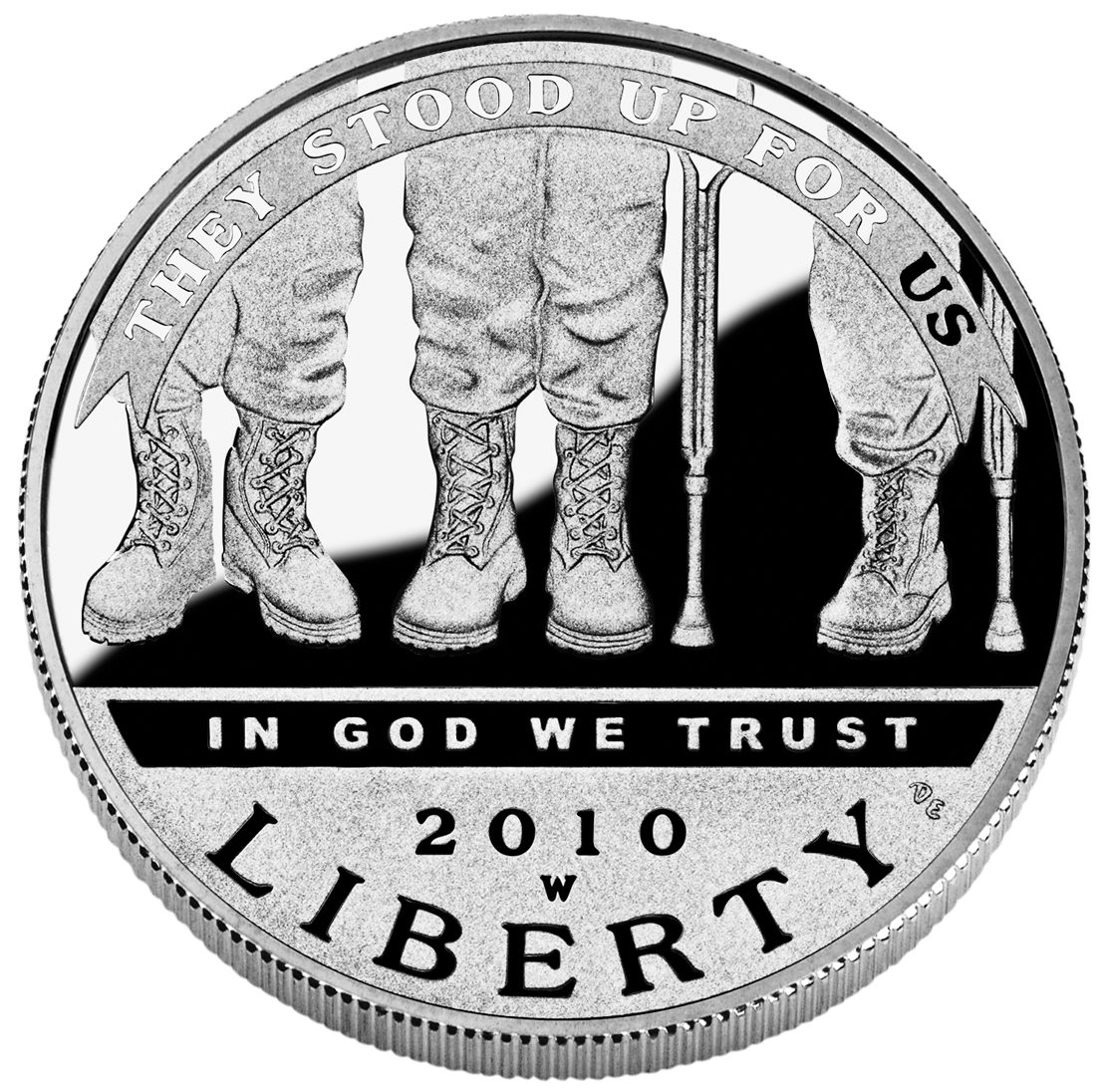
Look at the front of this dollar and you won't find a portrait. You'll find six feet, three pairs of boots, and a quiet act of design: a coin that asks you to look down before you look up. Every one sold sent ten dollars toward the first national memorial to America's disabled veterans.

A coin that looks down, not up

Almost every American coin shows a face — a president, a goddess, a profile gazing off into history. The 2010 American Veterans Disabled for Life silver dollar shows none of that. The front shows legs and boots. Three veterans, standing, cut off at the knee. One wears a prosthetic leg. One leans on a crutch. One simply stands. Above them, in a curved banner, four words: THEY STOOD UP FOR US.

It is one of the most unusual obverses — the "heads" side — the U.S. Mint has ever struck. And the choice was deliberate. A memorial to disabled veterans is not about rank or fame; it's about the price a body pays for service. The design makes you reckon with that before it tells you anything else.

The coin exists because of an act of Congress. The American Veterans Disabled for Life Commemorative Coin Act became Public Law 110-277 when President George W. Bush signed it on July 17, 2008. It ordered a single year of silver dollars, struck in 2010, with one purpose attached: raise money to build a memorial that did not yet exist.

What the coin depicts — and who designed it

The obverse was designed by U.S. Mint sculptor-engraver Don Everhart. Three pairs of legs, three different stories, no faces — strength shown through the body, not the gaze. The "W" mint mark sits there too: every one of these dollars was struck at the West Point Mint in New York.

The reverse — the "tails" side — was designed by Thomas Cleveland, an artist in the Mint's Artistic Infusion Program (a roster of outside designers the Mint invites in for fresh ideas), and sculpted by Mint engraver Joseph Menna. It carries a forget-me-not flower at the base of a wreath of oak branches bound in a ribbon. The pairing is older than the coin: the forget-me-not has stood for the war-wounded since World War I, and oak has long meant strength and endurance. The reverse legend reads, plainly, "Take This Moment to Honor Our Disabled Defenders of Freedom."

A strike is one stamping of a coin between two engraved steel dies; relief is how high the design rises off the field. On a 38-millimeter silver dollar, that gave Everhart and Cleveland real room — and the boots, in particular, carry weight precisely because they're rendered with care most coins reserve for a king's chin.

Key facts

Year struck
2010 (single year)
Mint
West Point (W mint mark)
Denomination
Silver dollar — commemorative, legal tender
Obverse design
Don Everhart — boots of three veterans, 'They Stood Up For Us'
Reverse design
Thomas Cleveland (designer), Joseph Menna (sculptor)
Composition
90% silver, 10% copper
Weight / diameter
26.73 g / 38.1 mm, reeded edge
Authorizing act
Public Law 110-277 (signed July 17, 2008)
Authorized mintage
350,000 maximum (both versions combined)
Actual mintage
281,071 total — 78,301 uncirculated, 202,770 proof
Surcharge
$10 per coin to the Disabled Veterans' LIFE Memorial Foundation

Collecting it

This is a modern commemorative, so the collecting math is different from a century-old rarity. The Mint sold it in two finishes in 2010 and 2010 only. The proof — struck on polished blanks with frosted, mirror-clear detail — was by far the more popular, at 202,770 coins. The uncirculated ("Brilliant Uncirculated") version is the scarcer of the two at 78,301. Neither was ever released into pocket change; both were sold straight from the Mint to collectors and supporters.

A proof is not a grade — it's a method of manufacture. Both finishes can be graded, and high grades (a flawless proof, or a top-tier uncirculated) command the premiums collectors chase. But the bigger story is supply: the Mint struck 281,071 of a possible 350,000 and then closed the program for good. There will never be another year. For a coin this affordable, that fixed, never-repeated supply is the whole appeal — plus, for many buyers, the cause it served.

That cause is the reason the coin is remembered. Every dollar carried a $10 surcharge — money added on top of the coin's price and paid, by law, to the Disabled Veterans' LIFE Memorial Foundation. The foundation was building the American Veterans Disabled for Life Memorial in Washington, D.C., on a triangular site just east of the U.S. Capitol. The memorial — the nation's first devoted solely to disabled veterans of every branch and every American war — was dedicated by President Barack Obama on October 5, 2014. Its roughly $81 million cost came entirely from private donations. The coin in your hand was part of that effort.

Questions collectors ask

Why does the coin show boots instead of a face?

The design is deliberate. The obverse by Don Everhart shows the legs and boots of three veterans — one with a prosthetic leg, one on a crutch, one standing — with the words 'They Stood Up For Us.' For a coin honoring disabled veterans, it puts the body and its cost front and center rather than a portrait.

How many were made?

Congress authorized up to 350,000. The Mint struck 281,071 in total: 78,301 in the uncirculated finish and 202,770 in proof. The program ran for 2010 only and was never repeated, so that figure is final.

What did the $10 surcharge pay for?

By law, $10 from each coin went to the Disabled Veterans' LIFE Memorial Foundation to help build the American Veterans Disabled for Life Memorial in Washington, D.C. — the first national memorial dedicated solely to disabled veterans. It was dedicated in 2014.

Which is rarer, the proof or the uncirculated?

The uncirculated version is scarcer, with 78,301 struck versus 202,770 proofs. Proofs are struck on polished blanks for a mirror finish; uncirculated coins have a standard satin look. Both were sold only by the Mint.

Where was it minted?

All examples were struck at the West Point Mint in New York and carry a 'W' mint mark on the obverse.

Sources