US coin · series

American Liberty 225th Anniversary High Relief Gold

The coin the U.S. Mint made for its own 225th birthday — and the first time Liberty was shown as a young woman of color.

American Liberty 225th Anniversary High Relief Gold
US Mint (source: U.S. Treasury, treasury.gov) · public domain · source

In 2017 the United States Mint turned 225, and to mark it the Mint did something it had never done: it struck a high-relief gold coin with a mirror-bright proof finish, and it put a brand-new Liberty on the front — youthful, confident, and African American. People lined up. People also argued. Either way, they noticed.

The story behind the coin

On April 2, 1792, Congress passed the Coinage Act and built the nation's first mint in Philadelphia — the first federal building raised under the new Constitution. That single law gave the young United States its own money. Two hundred and twenty-five years later, in 2017, the Mint decided to throw itself a birthday party in gold.

The result was the American Liberty 225th Anniversary Gold Coin: a $100 coin holding one full ounce of pure gold. It was a commemorative — a coin made to honor an occasion rather than to jingle in a pocket — and the occasion was the Mint's own long history.

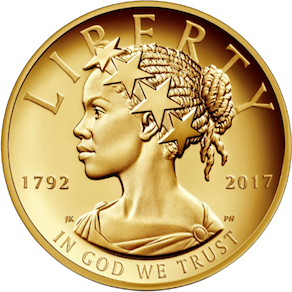
But the coin became famous for the figure on its face. For more than two centuries, Liberty on American coins had been a classical ideal: a stately woman, usually read as white, borrowed from Greek and Roman art. Here, for the first time, the Mint deliberately portrayed Liberty as a young African American woman wearing a crown of stars. The choice drew praise and pushback in equal measure, and it put a quiet question on a piece of gold: who, exactly, does "Liberty" look like?

The design, and who made it

The obverse — the heads side — shows Liberty in profile, youthful and self-possessed, her hair crowned with stars. Around her run the words LIBERTY and IN GOD WE TRUST, with the dates 1792 and 2017 binding the Mint's beginning to its 225th year. It was designed by Justin Kunz, an artist in the Mint's Artistic Infusion Program (a roster of outside artists the Mint invites to propose designs), and sculpted into metal by Mint Sculptor-Engraver Phebe Hemphill.

The reverse — the tails side — is all motion: a bald eagle in flight, wings spread, sweeping across the field. It was designed by Chris Costello, also of the Artistic Infusion Program, and sculpted by Mint Sculptor-Engraver Michael Gaudioso.

Two words explain why collectors call this coin special: high relief. Relief is how far a design rises off the flat surface of a coin. Most coins are struck shallow so they stack and wear well. High relief lets the design stand up dramatically, almost sculptural — but it takes far more pressure and more strikes to force the metal into a deep design. The Mint paired that deep relief with a proof finish — coins struck on specially polished dies to give mirror-like fields and frosted, sculpted devices. The 2017 piece was the first high-relief coin the United States ever struck as a proof. Hold one at an angle and the light pools and rolls across Liberty's face the way it never does on an ordinary coin.

Key facts

Year struck
2017 (West Point Mint, 'W' mint mark)
Denomination
$100
Composition
99.99% gold (.9999 fine)
Weight / diameter
31.108 g (1 troy oz) · 30.61 mm
Finish
Proof — the first U.S. high-relief coin struck as a proof
Obverse
Justin Kunz (design) · Phebe Hemphill (engraver)
Reverse
Chris Costello (design) · Michael Gaudioso (engraver)
Edge
Lettered — '225th ANNIVERSARY' between stars
Maximum authorized mintage
100,000
First-day sales (Apr 6, 2017)
14,285 coins

Collecting it: dates, varieties, and grade

This is a one-year, one-mint coin: every example is a 2017 struck at West Point, carrying the W mint mark (a tiny letter showing which Mint facility made it). There is no rare branch-mint version to hunt and no circulating counterpart. So the chase here is not about which coin — it's about how nice a coin, and about its place in a story.

Start with mintage. The Mint authorized up to 100,000 pieces, but demand fell well short of that ceiling — first-day sales were 14,285, and final sales (sources vary on the exact audited figure) landed only around half the cap. That makes it scarcer than its big authorized number suggests, though far from rare among modern gold issues.

Then grade. Coins are graded on a 70-point scale; a flawless proof is PR70 (often written PR70 DCAM — "Deep Cameo," for the strongest mirror-and-frost contrast). High-relief proofs are unforgiving: the deep, sculpted fields show every faint hairline and handling mark, so a perfect 70 is genuinely harder to earn than on a shallow coin. A large share of survivors grade PR69, one point shy of perfect — which is exactly why the gap to PR70 carries a premium. Collectors also chase early-release designations such as First Day of Issue, where a coin was submitted within the first days of sale.

What ultimately makes people chase this coin is the combination: the first-ever U.S. proof high relief, a modern reimagining of Liberty that made national news, and a full ounce of pure gold that gives it a hard floor of bullion value beneath the collector premium. It is a coin that is both an argument and an asset.

Questions collectors ask

Why is the 2017 American Liberty gold coin historically significant?

Two reasons. It was the first high-relief coin the U.S. Mint ever struck with a proof finish, and it was the first time the Mint deliberately portrayed Liberty as a young African American woman. It was issued to mark the Mint's 225th anniversary — 225 years after the Coinage Act of 1792 created the U.S. Mint.

Who designed the 2017 American Liberty coin?

The obverse Liberty was designed by Justin Kunz and sculpted by U.S. Mint engraver Phebe Hemphill. The reverse flying eagle was designed by Chris Costello and sculpted by Mint engraver Michael Gaudioso. Kunz and Costello are both artists in the Mint's Artistic Infusion Program.

What does 'high relief' mean, and why does it matter here?

Relief is how far a design rises off a coin's surface. High relief makes the design stand up dramatically — almost sculptural — but takes far more striking pressure to produce. The 2017 coin was the first time the U.S. combined that deep relief with a mirror-like proof finish, which is the heart of its appeal.

How much gold is in it, and what is it worth?

It contains one troy ounce of .9999 fine (99.99% pure) gold, so its melt value tracks the gold price. As a collectible proof with a low survival-relative mintage, examples — especially perfect PR70 pieces — typically trade above their gold content. Check current live listings for the price today.

Is the 2017 coin part of a larger series?

Yes. It belongs to the Mint's American Liberty high-relief gold program, released every other year since 2015, each issue showing a fresh modern interpretation of Liberty. The 2017 anniversary coin is the program's most historically loaded entry.

Sources