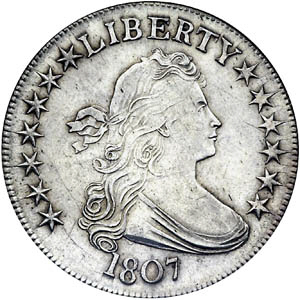
The story behind the coin
In the 1790s, the United States Mint had a money problem of its own making. People who brought silver to be coined got to say what they wanted back — and almost everyone wanted dollars. The big, impressive silver dollar was the coin of commerce and the coin of prestige. Hardly anyone asked for half dollars.
So the Mint barely made any. Across all of 1796 and 1797 combined, it struck just 3,918 half dollars. To put that in plain terms: a single modern coin press would produce that many in well under a minute. These were made by hand, on a screw press, one strike at a time — and only when someone specifically requested the denomination.
That scarcity is the whole story. The Draped Bust half dollar of 1796–1797 is widely regarded as the rarest circulation-strike U.S. silver type coin — rarer even than the famous 1796 quarter. Fewer than 300 are thought to survive today, most of them worn smooth from the few decades they did circulate. When one appears at auction, the early-American coin world stops to watch.
This was the dawn of American money. The Mint had opened in Philadelphia in 1792, the first federal building erected under the new Constitution. The men cutting these dies were inventing what United States coinage would look like, denomination by denomination, with no tradition to lean on. The half dollar got its turn in 1796 — and almost no one wanted it.