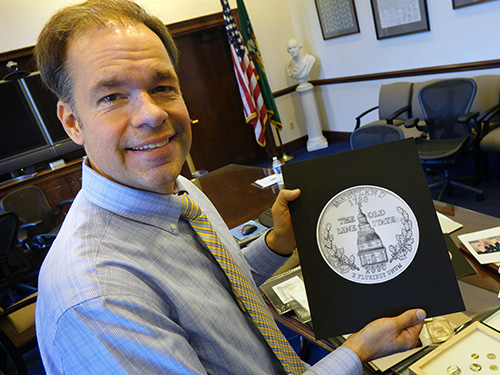
Designer

William J. Krawczewicz

The designer they call 'Dollar Bill' — because he draws the actual dollar bills.

William J. Krawczewicz
U.S. Mint · public domain · source

Most people who design U.S. money do it once, for one coin. William Krawczewicz did it for a living. He drew gold coins, then a state quarter a billion people carried, then the color and layout of the $10, $20, and $50 bills in your wallet.

Who he is

There are, at any given time, only a handful of people in America whose job is to decide what the nation's money looks like. For years, William J. Krawczewicz was one of them — so closely tied to the work that colleagues nicknamed him "Dollar Bill."

He was born in 1967 in Severna Park, Maryland, and studied at the University of Maryland, College Park. His first money job was at the United States Mint, the agency that makes the country's coins. From there his path took an unusual turn: he joined the design department of the Clinton White House, and that work led him to the Bureau of Engraving and Printing in Washington — the agency that prints America's paper currency.

That move is the whole story of his career in one sentence. Coins are struck in metal; paper money is engraved and printed. Krawczewicz is one of the rare designers who worked on both sides of that line, the metal and the paper.

The craft

A coin designer doesn't just make a pretty picture. The design — the obverse (the heads side) and the reverse (the tails side) — has to read clearly at the size of a fingernail, survive being struck into hard metal, and still say something. Krawczewicz worked at that scale, and then went smaller still.

At the Bureau of Engraving and Printing he was one of only three banknote designers in the country. He handled the redesigns of the $10, $20, and $50 bills — not the portraits in the center, but the color, the layout, and the small "freedom icons" woven into the newer notes. It is exacting work. He started with drawings and finished on the computer, by his own account sometimes adjusting a design "in increments as small as a few microns" — thousandths of a millimeter.

His coin work runs across the 1990s. He designed the obverse of the 1993 Bill of Rights commemorative silver dollar and the James Madison silver dollar. He worked on three coins for the 1996 Atlanta Summer Olympics, including the gold half eagles linked below. And in 2000 he designed the Maryland state quarter — a coin struck more than a billion times, which means his work has passed through more American hands than almost any artist's. He also designed President George W. Bush's official medal.

Key facts

Born
1967, Severna Park, Maryland, USA
Nationality
American
Education
University of Maryland, College Park
Roles
U.S. Mint; Clinton White House design dept.; Bureau of Engraving and Printing
Nickname
"Dollar Bill"
Coins
1994 World Cup $5 gold (obverse); 1996 Atlanta Olympic $5 gold; Maryland quarter (2000); Bill of Rights & James Madison silver dollars
Banknotes
Redesigns of the $10, $20, and $50 bills

A note in his own words

"I just really enjoy my job. I want the notes to look as beautiful as possible."

— William Krawczewicz, on designing U.S. currency (The E-Sylum, 2007)

Questions collectors ask

Why is he called 'Dollar Bill'?

It's a nickname tied to his job. As one of only three banknote designers at the Bureau of Engraving and Printing, Krawczewicz literally helped design U.S. paper money — including the redesigned $10, $20, and $50 bills — so 'Dollar Bill' stuck.

Which coins did William Krawczewicz design?

His coin work clusters in the 1990s: the obverse of the 1994 World Cup $5 gold coin, three coins for the 1996 Atlanta Olympics (including the $5 gold Cauldron reverse), the 1993 Bill of Rights and James Madison commemorative silver dollars, and the 2000 Maryland state quarter. He also designed President George W. Bush's official medal.

Did he design coins or paper money?

Both — which is unusual. He started at the U.S. Mint (coins), then moved to the Bureau of Engraving and Printing (paper currency). Few designers cross that line; most work in only one medium.

What's his most widely circulated work?

Almost certainly the Maryland state quarter, released in 2000 and struck more than a billion times. By sheer number of pieces in pockets, it dwarfs his gold commemoratives — though those are far scarcer and more sought by collectors.

Sources