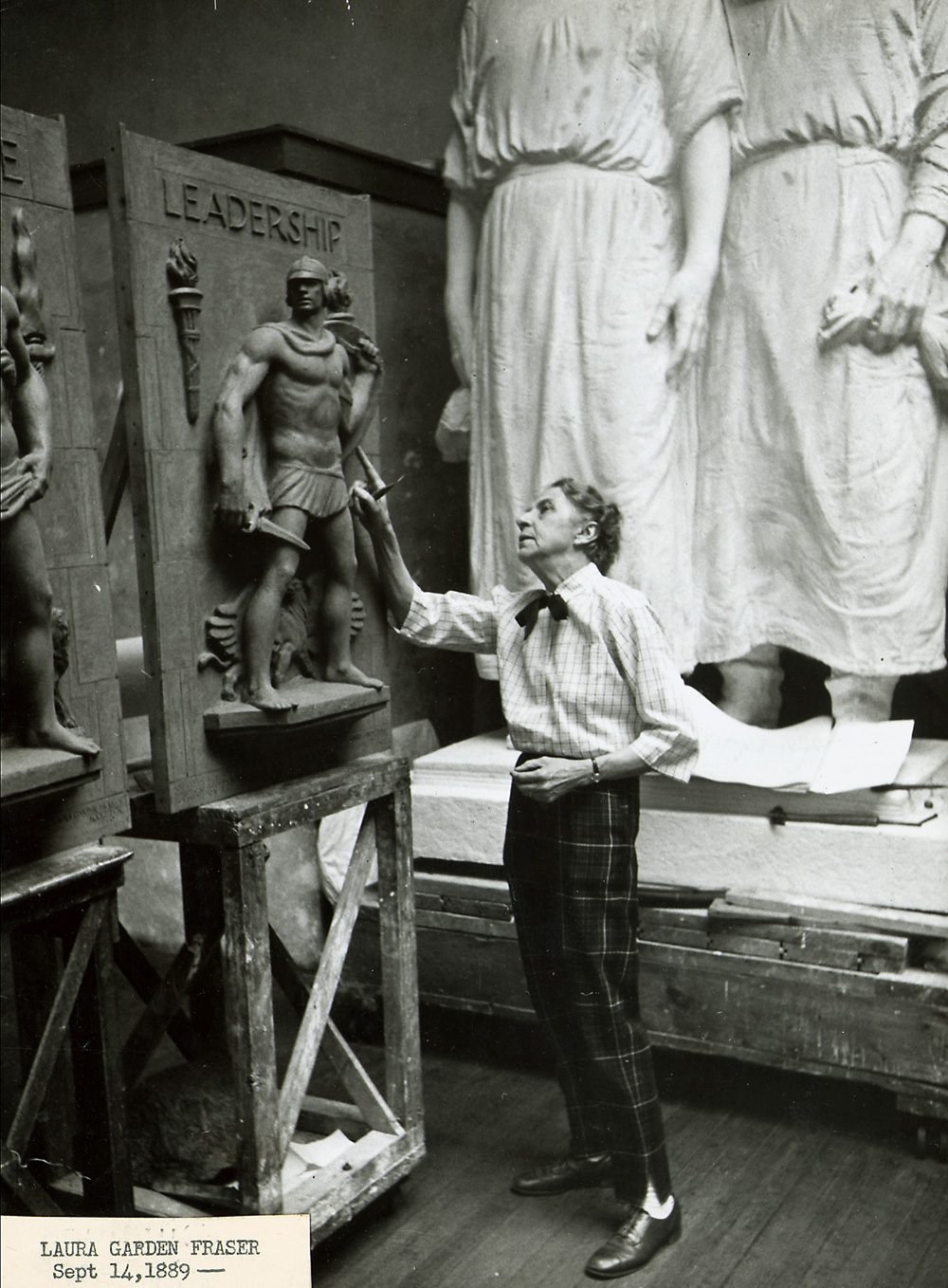
Designer

Laura Gardin Fraser: the sculptor who won the quarter twice — and waited 90 years to be right

The first woman to design an American coin. Twice chosen to portray Washington. Overruled by one man. Vindicated by history.

Laura Gardin Fraser: the sculptor who won the quarter twice — and waited 90 years to be right
USCapitol (U.S. Capitol Flickr stream) · public domain · source

In 1932 a panel of experts twice picked Laura Gardin Fraser's portrait of George Washington for the new quarter. The Treasury Secretary overruled them and chose a man's design instead. Her Washington sat in a drawer for ninety years — until 2022, when it finally landed in every American's change.

Who she was

Laura Gardin Fraser had a talent and a problem. The talent was for putting a face into metal so cleanly that people felt they'd met the person. The problem was the year she was born into it.

She came into the world in Chicago in 1889, the daughter of a mother who handed her clay early. By 1907 she was in New York at the Art Students League — the country's most serious art school — studying sculpture under a rising star named James Earle Fraser. He was already famous, or about to be: his design for the Buffalo nickel, the Indian head on one side and the bison on the other, became one of the most beloved coins America ever struck. In 1913 Laura married her teacher. For the rest of her life she would be measured against him.

She did not lose that measurement. While James worked on monuments, Laura quietly became the finest medallic sculptor in America — meaning she was a master of the small, the disciplined, the round: medals, plaques, and coins, where every line has to count because there's no room for a wasted one. In 1926 the American Numismatic Society gave her its J. Sanford Saltus Award, the highest honor in medallic art. She was the first woman ever to win it. Her husband had been the very first winner, seven years earlier. Now the Fraser name belonged to both of them.

The craft

A coin is a brutal test of a sculptor. You get a disc smaller than a bottle cap and a relief — the height a design rises off the flat surface — measured in fractions of a millimeter. Crowd it, and the dies that strike the coins clog and crack. Underdo it, and the portrait goes flat and dead. Fraser had the rare instinct for exactly how much to leave out.

Her signature was the portrait that breathes. She favored the clean profile — a head seen from the side — and she studied her subjects until the likeness felt inevitable rather than copied. When she turned to George Washington, she went back to the source: the 1785 life bust by the French sculptor Jean-Antoine Houdon, who had actually measured Washington's living face. Fraser's Washington isn't a painting copied onto metal. It's a sculptor's reading of another sculptor's reading of the man himself. A federal arts panel later called it "the most authentic likeness of Washington," praising its "simplicity, directness, and nobility."

She could also work big. The same hands that cut a half-dollar portrait carved heroic equestrian statues and relief panels for the library at West Point. But the coins are where her discipline shows cleanest — and where the establishment kept telling her no.

The fight over the quarter

In 1931, the country planned a new quarter to mark the 200th anniversary of Washington's birth. The U.S. Commission of Fine Arts — the government's official panel of art experts — ran the review. They looked at the submissions and chose Laura Gardin Fraser's Washington. The obverse — the "heads" side — was her Houdon-based profile.

Then Treasury Secretary Andrew W. Mellon, who held the final say, picked a different design: a portrait by the sculptor John Flanagan. The Commission protested. They resubmitted. In January 1932 they affirmed their choice of Fraser a second time. Mellon's reply was, essentially, that the Treasury hadn't agreed to be bound by the panel and wouldn't be. When Mellon left office, his successor Ogden Mills inherited the fight — and refused to overturn his predecessor. In April 1932 Flanagan's design was announced. That is the Washington quarter that went into circulation, and Flanagan's portrait has been on the quarter ever since.

Why Fraser lost is still argued. The plain fact is that the experts wanted her twice and one official said no twice. Some collectors and historians have long suspected her being a woman was the unspoken reason — a charge that's plausible but not something the surviving documents prove outright. What is documented is the outcome: the best-regarded design, recommended twice, set aside.

The ninety-year vindication

Here's the turn that makes Fraser's story worth telling. Her Washington didn't die in 1932 — it waited.

In 1999, the Mint pulled her design out of the archive and struck it on a $5 gold commemorative for the bicentennial of Washington's death, paired with an eagle reverse she had also designed. A glimpse, then back in the drawer.

Then in 2022, the Mint launched the American Women Quarters — a four-year series, running through 2025, honoring trailblazing women. For the obverse of every coin in that series, the Mint chose Laura Gardin Fraser's portrait of Washington. The design a panel had picked twice in 1932, and that one man had overruled, finally became the everyday quarter — on coins celebrating American women, designed by the first woman to ever design an American coin. Few artists get a verdict reversed by history. Fraser got hers stamped into hundreds of millions of coins.

Key facts

Born
September 14, 1889 — Chicago, Illinois
Died
August 13, 1966 — Norwalk, Connecticut
Nationality
American
Training
Art Students League of New York, under James Earle Fraser (whom she married in 1913)
Signature U.S. coins
Alabama Centennial half dollar (1921); Grant Memorial gold dollar & half dollar (1922); Fort Vancouver Centennial half dollar (1925); Oregon Trail Memorial half dollar (1926, with James Earle Fraser)
First in history
First woman to design a U.S. coin (Alabama Centennial, 1921); first woman to win the J. Sanford Saltus Award (1926)
Washington portrait
Chosen twice by the Commission of Fine Arts in 1931–32; overruled; revived on a 1999 $5 gold commemorative; adopted as the American Women Quarters obverse, 2022–2025

A note on her Washington

This bust is regarded by artists who have studied it as the most authentic likeness of Washington. Simplicity, directness, and nobility characterize it.

— U.S. Commission of Fine Arts, recommending Laura Gardin Fraser's Washington design to the Treasury, 1932

Questions collectors ask

Who was Laura Gardin Fraser?

An American sculptor (1889–1966) and the leading medallic artist of her generation — meaning a specialist in coins, medals, and plaques. She was the first woman to design a U.S. coin, and the first woman to win the American Numismatic Society's J. Sanford Saltus Award for medallic art.

Did Laura Gardin Fraser design the Washington quarter?

She designed the Washington portrait that the Commission of Fine Arts recommended twice in 1931–32 — but the Treasury overruled the panel and chose John Flanagan's design for the circulating quarter. Fraser's portrait was finally adopted decades later as the obverse of the American Women Quarters, struck 2022 through 2025.

Why wasn't her 1932 design used at the time?

Treasury Secretary Andrew Mellon, who had the final decision, picked John Flanagan's design instead, even after the Commission of Fine Arts chose Fraser's twice. His successor declined to reverse it. Some historians suspect her gender played a role; the surviving records show the override but don't state the reason outright.

Was she really the first woman to design a U.S. coin?

Yes. Her 1921 Alabama Centennial half dollar was the first U.S. coin designed by a woman — and, by most accounts, the first coin designed by a woman for any country. It also carried the first living person ever depicted on a U.S. coin, Governor Thomas Kilby.

What is the connection to James Earle Fraser?

James Earle Fraser, designer of the Buffalo nickel, was her sculpture teacher at the Art Students League and became her husband in 1913. The two collaborated on the 1926 Oregon Trail Memorial half dollar. Both won the Saltus Award — he in 1919, she in 1926.

Sources