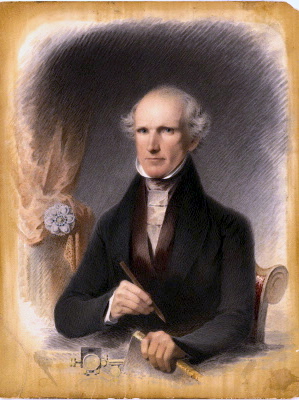
Who he was
James Barton Longacre was born on a Pennsylvania farm in 1794 and ran away from it at twelve. His mother had died young; he could not get along with his stepmother, so he walked to Philadelphia and apprenticed himself to a bookseller. That should have been the end of the story — a farm boy filing books in a city shop.
But he could draw. By 1813 his employer released him to learn engraving instead, and Longacre trained under George Murray, one of the best banknote engravers in the country. Banknote work is exacting: every line is cut by hand into metal, in reverse, with no margin for a slip. It taught him a portraitist's eye and a craftsman's patience.
He went out on his own in 1819 and made his name not on coins but on paper. He engraved portraits of the Founders for John Binns' famous broadside of the Declaration of Independence. In the 1830s he and the New York artist James Herring published the National Portrait Gallery of Distinguished Americans — volumes of engraved portraits of the men who had built the young republic. By 1844, Longacre was one of the most respected portrait engravers in the United States.
Then the U.S. Mint's chief engraver, Christian Gobrecht, died. Longacre wanted the job, and a powerful friend — Senator John C. Calhoun of South Carolina — helped him get it. President John Tyler appointed him the fourth Chief Engraver of the United States Mint in September 1844. He had almost no experience cutting coin dies. That gap, and the politics behind his hiring, would haunt him for years.